
Related News
 How Does the EU Carbon Border Tax Affect Steel Exports?Oct 08, 2026
- What Maintenance Costs Should You Expect for Imported Construction Machinery?Oct 08, 2026
- Are Carbon Fiber Composites Ready for Mass Use in Construction Equipment?Oct 08, 2026
- How to Verify an Industrial Supplier’s Delivery Track RecordOct 08, 2026




Industry Briefing
Get the top 5 industry headlines delivered to your inbox every morning.
Related News
Galvanized Steel Coil Standards Guide: How Buyers Can Control Grade, Coating, Inspection, and Export Documentation Risk





Coated steel purchasing can look straightforward when the inquiry only lists thickness, width, grade, and quantity, but real project risk often sits inside the details that are easy to overlook. For buyers comparing Galvanized Steel Coil, the critical questions are not limited to price per ton; they include coating mass, base steel grade, surface treatment, dimensional tolerance, inspection records, packing, marking, and whether the document package supports the target market.
This standards and certification guide is designed for importers, building material distributors, roofing and cladding suppliers, appliance manufacturers, steel service centers, fabrication buyers, and project procurement teams. The goal is to make galvanized coil evaluation more controlled before an order is placed. A coil can appear acceptable in product photos, but if the zinc coating specification is unclear, the grade is not aligned with forming requirements, or the certificate does not match the purchase order, the buyer may face disputes during processing, customs review, customer acceptance, or later warranty discussions. Good procurement is therefore not only a commercial activity. It is a documentation and specification discipline.
Why Standards Matter in Galvanized Coil Sourcing
Galvanized coil is used because a zinc layer helps protect steel from corrosion in many environments. The product is widely applied in roofing, wall panels, ducts, appliances, garage doors, light steel framing, fabrication parts, equipment shells, agricultural structures, storage systems, and general industrial components. Because the material moves through different production routes after purchase, the buyer must ensure that the coil is suitable for cutting, slitting, roll forming, stamping, bending, profiling, painting, or installation.
Standards create a common language between the buyer and supplier. They help define base steel grade, coating requirement, surface finish, chemical composition, mechanical properties, dimensional tolerance, and testing expectations. Without a clear standard, two suppliers may quote products that have the same commercial name but different technical value. One offer may include a heavier zinc coating, a more suitable forming grade, or better surface protection, while another may only meet a basic stock description. A buyer who compares only the lowest price may unknowingly compare different scopes.
Standards also reduce communication risk across borders. A buyer in one market may be familiar with ASTM references, while another may use EN, JIS, GB, or other national and regional systems. Equivalent grades can sometimes be discussed, but equivalence should be confirmed carefully. A grade name alone is not enough; the buyer should review mechanical properties, coating mass, dimensional tolerance, surface quality, and intended use.
Key Standards and Grade Families Buyers Often Encounter
Galvanized steel coil is commonly discussed under several standard families depending on region and application. ASTM A653 is often referenced in North American supply contexts for steel sheet, zinc-coated or zinc-iron alloy-coated by the hot-dip process. EN 10346 is widely used for continuously hot-dip coated steel flat products in European contexts. JIS G3302 is associated with hot-dip zinc-coated steel sheets and coils in Japanese standard terminology. Chinese GB standards may also be used for domestic production and export supply. Buyers do not need to memorize every clause, but they should know which standard is being quoted and whether their customer or project requires a specific one.
Grade families matter because galvanized coil may be selected for different processing requirements. Commercial quality material may be suitable for general fabrication, while drawing or deep drawing grades are used where forming performance is more demanding. Structural grades are considered where strength is important. High-strength grades may support lightweight design, but they may also require more careful forming and tooling review. A buyer should never assume that any galvanized coil can be substituted for another simply because the zinc coating looks similar.
For example, grade names such as DX51D, DX52D, DX53D, DX54D, S220GD, S250GD, S280GD, S320GD, S350GD, and S550GD are often seen in EN-style coated steel discussions. These grade labels point toward different forming or structural expectations. The appropriate choice depends on the final product. A roofing panel, a duct component, a stamping part, and a light structural section may all need galvanized steel, but they may not need the same base steel performance.
Coating Mass, Surface Treatment, and Corrosion Expectations
Zinc coating is one of the most important parts of the specification. Buyers may see coating designations such as Z80, Z100, Z120, Z180, Z275, or similar descriptions depending on the applicable standard and market convention. The number usually relates to coating mass, but the exact interpretation should be tied to the standard and document language. More coating is not automatically better for every use. Heavier coating may improve corrosion allowance in many conditions, but it can also influence forming behavior, surface appearance, and cost.
The buyer should define the service environment before choosing coating mass. Indoor dry use, temporary protection, roofing exposure, coastal construction, agricultural buildings, and industrial atmospheres place different demands on the coating. If the coil will be painted after profiling, the buyer should also consider surface treatment and paint compatibility. Passivation, oiling, anti-fingerprint treatment, chromate-free treatment, or other surface conditions may be relevant depending on end use and regulatory expectations.
Surface finish should be agreed before ordering. Spangle appearance, surface smoothness, oil level, edge condition, and visible defects may affect downstream processing and customer acceptance. A distributor selling into roofing or façade applications may place high value on consistent appearance. A fabricator using hidden parts may prioritize forming reliability and corrosion protection. The right specification should reflect the real product path.
Certification and Document Packages
In steel export purchasing, documentation is part of the product. A buyer may need a mill test certificate, quality certificate, commercial invoice, packing list, certificate of origin, bill of lading, inspection photos, loading photos, and sometimes third-party inspection records. The required documents depend on the destination market, customer contract, payment terms, and project requirements. A supplier should not guess which documents matter; the buyer should list them clearly in the inquiry and purchase order.
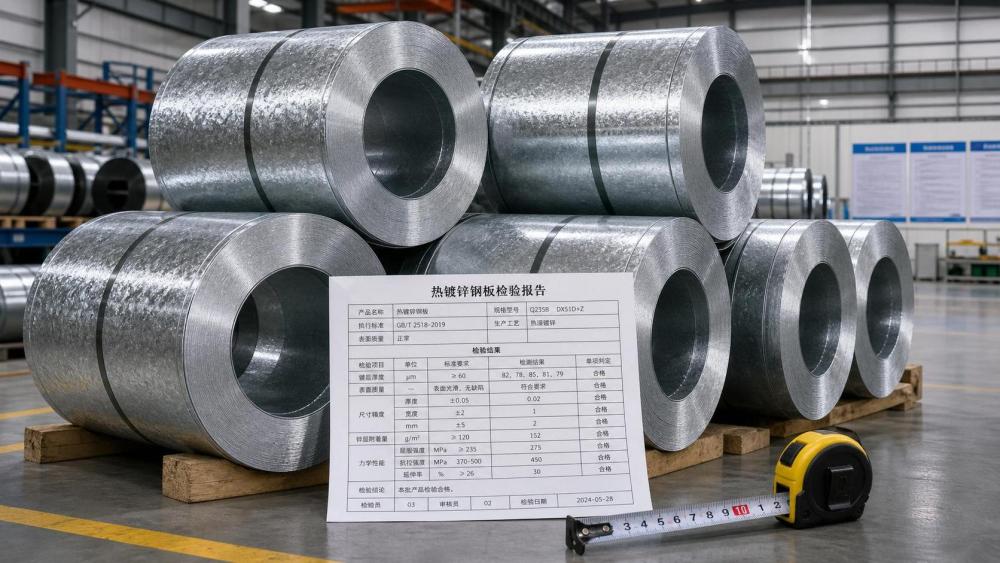
The mill test certificate should be reviewed for consistency. Important fields may include supplier name, product description, grade, standard, heat or coil number, chemical composition, mechanical properties, coating mass, dimensions, quantity, and test date. The details should match the purchase order and packing list. If the buyer orders several grades, widths, or coating designations in one shipment, the document package should keep those items easy to identify. Confusing paperwork can delay customs clearance, warehouse sorting, and customer delivery.
For regulated or sensitive markets, buyers may also need to confirm whether surface treatments meet customer restrictions. For example, chromate-free or RoHS-related expectations can appear in some downstream industries. The supplier should not claim compliance casually. If a customer requires a specific compliance statement, the wording and evidence should be confirmed before production. This avoids last-minute document disputes after the coil has already shipped.
Inspection Points Before Shipment
Pre-shipment inspection should be planned according to order risk. For routine stock orders, buyers may request dimensional confirmation, surface photos, label photos, package photos, and certificate review. For project-based or large-volume orders, more detailed inspection may be appropriate. The inspection scope can include thickness measurement, width measurement, coil weight check, visual surface review, coating confirmation based on supplied records, edge condition, coil ID, packing method, and shipping marks.
Surface inspection should not focus only on whether the coil looks bright. Buyers should look for scratches, white rust, stains, dents, edge waves, telescoping, loose winding, water damage, and packing problems. Some minor surface conditions may be acceptable depending on the application, while others can affect downstream painting, roll forming, or resale value. Acceptance criteria should be defined before inspection so both sides understand what is considered acceptable.
Packing inspection is also important. Galvanized coil is vulnerable to moisture, handling damage, and edge impact during long-distance transport. Export packing should suit the route, container loading method, destination handling equipment, and storage conditions. Eye-to-wall and eye-to-sky loading requirements should be clarified where relevant. Labels and shipping marks should be readable and should match the documents. If several coil sizes are shipped together, clear marking reduces warehouse confusion.
How Standards Affect Downstream Processing
Downstream processing is where specification errors become visible. A coil selected for general use may not perform well in deep drawing. A high-strength grade may reduce material thickness but require different forming parameters. A coating mass that works for a dry indoor part may be insufficient for outdoor exposure. A surface treatment that protects the coil during storage may not be ideal for painting unless compatibility is confirmed. These issues are easier to solve before ordering than after the material reaches the workshop.
Roll forming buyers should review yield strength, elongation, thickness tolerance, coating behavior, and surface requirements. Stamping buyers should pay close attention to forming grade, lubrication, surface cleanliness, and tool condition. Roofing and cladding buyers should review coating mass, spangle, surface appearance, width tolerance, and packing. Steel service centers should confirm coil weight, inner diameter, outer diameter, edge condition, and slitting performance. A single product name cannot answer all of these questions.
When the buyer provides the supplier with the processing route, the supplier can better suggest suitable grades and delivery conditions. If the buyer hides the application and only requests the cheapest available coil, the risk of mismatch increases. Transparent technical communication is one of the simplest ways to reduce claims.
Supplier Qualification for Standard-Based Steel Orders
A qualified galvanized coil supplier should be able to explain the available grades, coating ranges, standard references, surface treatments, packing methods, and document options. The supplier should also be willing to clarify what is included in the quotation. For example, does the price include export seaworthy packing, specific coil weight, anti-rust measures, certificate copies before shipment, loading photos, or special labeling? These details affect real delivered value.
Buyers should also evaluate response quality. If a supplier cannot clearly answer questions about coating mass, grade equivalence, surface treatment, or document consistency, the buyer should be cautious. Fast replies are useful, but technical accuracy is more important. A supplier who asks for end-use details may be helping the buyer avoid a mismatch. For repeat purchases, the buyer can build a supplier scorecard covering specification accuracy, document quality, on-time delivery, packing condition, claim handling, and consistency between shipments.
When comparing quotations, buyers should avoid treating every offer as equal. A lower price may exclude important requirements. A higher price may include stronger packing, better documentation, or a coating designation more suitable for the end market. The best decision is the one that fits the technical need, commercial risk, and delivery plan together.
Buyer Checklist for Standards and Compliance Review
- Confirm the required standard system before comparing quotations.
- Specify base steel grade, coating designation, thickness, width, coil ID, coil weight, surface condition, and edge requirement.
- State whether equivalent grades are allowed and who must approve them.
- Define surface treatment requirements, especially for painting, storage, or regulated downstream markets.
- Request the document package before shipment and check consistency with the purchase order.
- Agree on inspection scope, photo requirements, acceptance criteria, and packing method.
- Confirm export marks, labels, coil numbers, and packing list details for warehouse traceability.
- Compare offers based on total delivered value, not only price per ton.
FAQ
Which standard is best for galvanized coil?
There is no single best standard for every order. The correct standard depends on the destination market, customer requirements, application, and processing route. Buyers should use the standard required by their project or customer and confirm equivalent grades only after technical review.
Is heavier zinc coating always better?
Not always. Heavier coating can support corrosion resistance in many applications, but it may affect cost, surface behavior, and forming performance. The coating should match the service environment and downstream processing method.
What documents should buyers request?
Common documents include mill test certificate, quality certificate, invoice, packing list, certificate of origin when required, shipment documents, inspection photos, and loading photos. Project or customer contracts may require additional documents.
Can galvanized coil be painted after purchase?
It can often be painted or coated, but surface treatment and preparation matter. Buyers should confirm paint compatibility, oiling, passivation, and cleaning requirements before ordering material intended for painting.
How can buyers reduce quality disputes?
Disputes can be reduced by confirming standard, grade, coating, dimensions, surface treatment, packing, inspection criteria, and document requirements in writing before production or shipment. Clear records make claims easier to evaluate objectively.
Editorial Review Note
This article is buyer-facing standards and documentation guidance for coated steel sourcing. It avoids fabricated prices, unsupported market statistics, invented project cases, false certifications, and guaranteed performance claims.