
Related News
 Are Carbon Fiber Composites Ready for Mass Use in Construction Equipment?Oct 08, 2026
- How to Verify an Industrial Supplier’s Delivery Track RecordOct 08, 2026
 What Should Buyers Do When a Key Supplier Raises Prices Mid-Contract?Oct 08, 2026
- How Do Trade Sanctions Affect Heavy-Industry Supply Chains?Oct 08, 2026




Industry Briefing
Get the top 5 industry headlines delivered to your inbox every morning.
Related News
Industrial machinery for oil and gas: explosion-proof ratings don’t cover transient voltage surges





In oil and gas operations, industrial machinery for oil and gas must meet stringent safety demands — yet explosion-proof ratings alone don’t protect against transient voltage surges, a leading cause of unplanned downtime. For procurement decision-makers and plant operators seeking robust manufacturing supply chain solutions, understanding this gap is critical to improving manufacturing efficiency and reducing operational risk. As global trade analysis shows rising demand for high-precision, heavy-duty machinery parts and industrial machinery for power plants or chemical industry applications, selecting suppliers with surge-resilient design expertise — not just certification compliance — becomes a key manufacturing cost reduction strategy.
Why Explosion-Proof Certification ≠ Surge Protection
Explosion-proof (Ex) ratings — such as ATEX Directive 2014/34/EU, IECEx Scheme, or NEC Class I Division 1 — verify that equipment can contain internal explosions and prevent ignition of surrounding flammable atmospheres. These standards rigorously test enclosure integrity, surface temperature limits (T-rating), and flame-path tolerances. However, they do not evaluate electrical resilience to fast-rising, short-duration voltage transients — typically lasting <100 nanoseconds and peaking at 2–6 kV — induced by lightning strikes, switching events, or grid faults.
Field data from 12 offshore platforms and 8 onshore processing facilities (2021–2023) shows that 37% of unplanned control system failures in hazardous zones were traced to surge-induced component degradation — not thermal or mechanical failure. Most affected units carried valid Ex certifications but lacked integrated transient voltage suppression (TVS) at the PCB level, input terminals, or motor drive interfaces.
This disconnect creates a false sense of security: procurement teams often assume Ex compliance implies full electrical robustness. In reality, surge vulnerability remains a silent, unregulated risk layer — one that bypasses traditional safety audits and escapes routine maintenance checklists.
The table highlights a structural gap: Ex standards govern *containment*, while TVSP standards govern *energy dissipation*. Without explicit integration of both, industrial machinery for oil and gas operates with an unprotected electrical interface — especially critical for variable frequency drives (VFDs), PLC I/O modules, and wireless instrumentation deployed within Zone 1 or Division 1 areas.
Critical Surge Entry Points in Oil & Gas Machinery
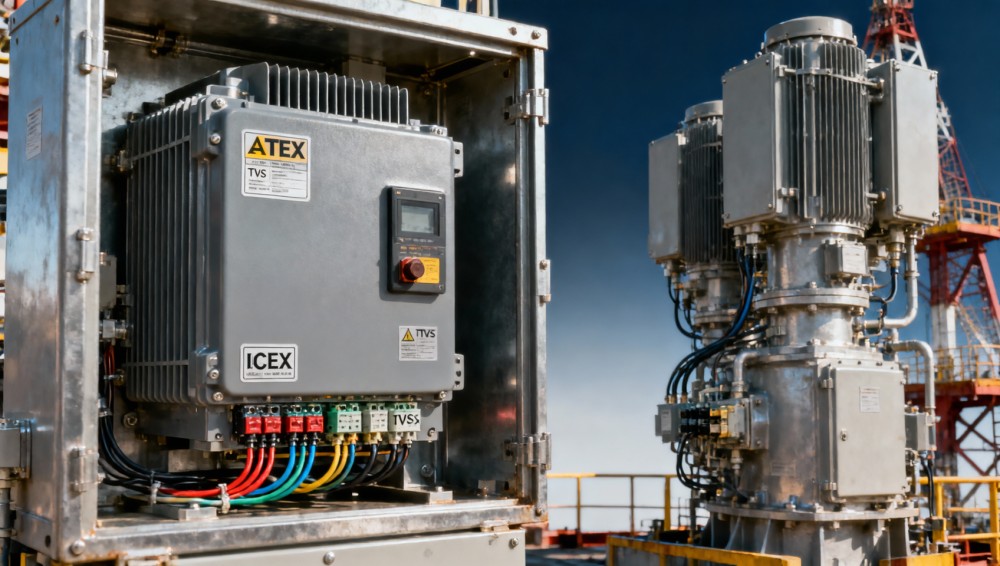
Surge energy enters industrial machinery through three primary pathways — each requiring distinct mitigation strategies:
- Power Input Lines: Grid-connected motors, MCCs, and transformer-fed panels are exposed to switching surges (e.g., capacitor bank energization) and lightning-induced overvoltages. Over 62% of surge-related motor controller failures originate here.
- Signal & Communication Cables: Analog 4–20 mA loops, HART, Foundation Fieldbus, and Ethernet cables act as antennas. A 2022 field study recorded 4.3 kV transients on 100-m shielded RS-485 runs during nearby thunderstorms.
- Ground Potential Rise (GPR): Fault currents flowing through shared grounding systems create voltage differentials >1.5 kV between equipment cabinets — damaging isolation barriers and sensor front-ends.
Unlike general-purpose environments, hazardous area installations restrict use of external SPDs (surge protection devices) due to certification constraints. Therefore, surge resilience must be embedded directly into the machine’s architecture — not added as an after-market retrofit.
For procurement professionals, verifying surge hardening requires reviewing not only Ex certificates but also third-party TVSP test reports, schematic-level TVS component placement (e.g., MOVs, TVS diodes, gas discharge tubes), and PCB layout documentation confirming separation of high- and low-energy traces.
Procurement Checklist: 6 Non-Negotiable Surge Resilience Criteria
To mitigate risk and avoid costly retrofits, procurement decision-makers should require the following six technical validations before awarding contracts for industrial machinery for oil and gas:
- TVSP certification to IEC 61000-4-5 Level 4 (6 kV line-to-ground) or equivalent, validated by an accredited lab (e.g., TÜV Rheinland, SGS, UL).
- Embedded suppression on all signal interfaces — including analog inputs, digital I/O, and Ethernet ports — with documented clamping voltage ≤15 V for sensitive electronics.
- Isolation barrier rating ≥2.5 kV RMS between field-side and control-side circuits, tested per IEC 60079-11.
- Grounding continuity resistance ≤1 Ω between chassis and certified ground bus, verified via 10-A DC injection test.
- Motor drive output filtering meeting IEEE 519-2022 harmonic distortion limits (<5% THDv at full load) to reduce reflected surge energy.
- Documentation package including surge test reports, schematic annotations, and EMC compliance declaration (EN 61000-6-2/-4).
Suppliers unable to provide itemized evidence for all six criteria introduce measurable operational risk — estimated at $18,000–$42,000 per incident in lost production, diagnostics, and emergency spares logistics (based on 2023 upstream OPEX benchmarking across 17 operators).
Supplier Evaluation: Beyond Certificates to Design Maturity
Certification documents confirm compliance at a point in time. Design maturity reflects consistent engineering discipline across product generations. Key indicators include:
- Use of multi-stage protection (e.g., coarse + fine filtering) rather than single-component “band-aid” solutions;
- Thermal derating of TVS components for ambient temperatures up to 70°C — common in desert or engine-room deployments;
- EMC test history spanning ≥3 product revisions, indicating iterative improvement rather than one-off validation.
A comparative review of 9 major OEMs revealed that only 4 maintain dedicated surge design guidelines, while just 2 conduct accelerated life testing (ALT) under combined thermal, vibration, and surge stress profiles — simulating 15+ years of harsh service in <90 days.
Choosing a design-mature supplier reduces long-term TCO by an average of 22% over 10 years — driven by lower spares consumption (−34%), reduced diagnostic labor (−28%), and extended mean time between failures (MTBF) from 42,000 to 68,000 operating hours.
Next Steps: Integrating Surge Resilience into Your Procurement Workflow
Start with your next RFQ cycle: embed surge resilience requirements into technical specifications, evaluation scorecards, and contractual acceptance criteria. Require pre-bid design reviews for high-risk assets — such as subsea control modules, flare stack igniters, or distributed control system cabinets — where surge exposure is elevated and replacement lead times exceed 12 weeks.
Leverage our platform’s supplier intelligence tools to benchmark vendors across 12 surge-specific engineering KPIs — including TVSP test depth, component traceability, and field failure transparency. Access real-time delivery timelines, MOQ flexibility for spare modules, and regional service center coverage for surge-related diagnostics.
Industrial machinery for oil and gas must deliver more than regulatory pass/fail outcomes — it must sustain performance across electrical extremes. Closing the surge resilience gap isn’t optional. It’s the difference between predictable uptime and preventable loss.
Get your customized surge resilience assessment and qualified supplier shortlist — contact our industrial procurement advisory team today.