
Related News
 US Refiners Shift Output From Gasoline to Middle DistillatesNov 06, 2026
- China's Steel Output Falls 2.9% in 2026 as Industry Shifts to High-Performance SteelNov 05, 2026
- China Tightens Technology Export Controls on Tunnel Boring Machines and DronesNov 04, 2026
- World Steel Association Issues Climate Change and Steel Production Position PaperNov 02, 2026


Industry Briefing
Get the top 5 industry headlines delivered to your inbox every morning.
What Is the Typical Lead Time for Custom Manufacturing Machinery?





What Is the Typical Lead Time for Custom Manufacturing Machinery?
For industrial buyers planning an equipment upgrade, a new production line, or a capacity expansion, lead time is not a minor purchasing detail. It affects construction sequencing, workforce planning, working capital, commissioning windows, and sometimes the timing of regulatory approvals. The question, “what is the typical lead time for custom manufacturing machinery orders,” does not have one universal answer because custom equipment is rarely a single product moving through a standard fulfillment process.
A relatively simple adaptation of an existing machine platform may move from approved drawings to shipment in a matter of months. A fully engineered system involving heavy fabrication, specialized drives, controls integration, safety systems, site-specific utilities, and acceptance testing can take substantially longer. If international transport, installation, or local compliance work is included, the practical project timeline extends beyond the factory delivery date.
The useful way to assess lead time is therefore not to ask only, “When can it ship?” Buyers should ask what has to happen before shipment can be promised, which items control the critical path, and what assumptions the supplier has made about approvals, components, logistics, and site readiness.
A practical range: from configured equipment to engineered production systems
Custom machinery usually falls into three broad categories. The distinction matters more than a headline lead-time estimate.
For planning purposes, buyers often see configured equipment discussed in terms of weeks or a few months, while modified systems commonly require several months. A complex custom line may require many months from technical clarification through final delivery, especially when it includes large fabricated structures, imported controls hardware, advanced process equipment, or customer-specific performance tests. These are planning ranges rather than contractual commitments. The only dependable schedule is one tied to an approved scope, a bill of materials, supplier capacity, and agreed milestones.
One recurring mistake is treating a supplier’s “manufacturing lead time” as the entire project duration. That figure may begin only after design approval, receipt of deposit, clarification of technical exceptions, and release of long-lead purchases. In a capital project, those preliminary stages can be decisive.
Where the time actually goes
Engineering is often the first major variable. A request may appear straightforward until the supplier needs to confirm material characteristics, throughput targets, duty cycle, ambient conditions, control interfaces, foundation loads, maintenance access, and operator safety requirements. Heavy equipment used in steel processing, mining, petrochemicals, energy facilities, building-material production, or bulk handling is particularly sensitive to these details. A late change to feedstock dimensions or a plant layout interface can require a redesign of more than one subsystem.
Procurement follows closely behind. Gearboxes, motors, bearings, hydraulic components, sensors, PLC hardware, variable-frequency drives, industrial computers, specialized valves, and high-specification electrical items may each have their own sourcing cycle. A machine builder can complete a fabricated frame while still waiting for one critical component that prevents assembly or functional testing. During periods of volatile industrial demand, the availability of these purchased items can change more quickly than the availability of steel plate or conventional machining capacity.
Fabrication and machining are not interchangeable activities. Large welded structures may require material preparation, fit-up, welding, stress-relief treatment where the design calls for it, machining, inspection, coating, and rework. A high-precision assembly may instead be limited by spindle time, specialist machining, metrology, or the availability of a qualified subcontractor. The production route should be visible in the supplier’s schedule rather than reduced to a single unexplained “build period.”
Controls integration adds another layer. The machine may need to exchange signals with upstream conveyors, plant MES systems, safety circuits, dust collection, robotics, utility systems, or existing legacy equipment. Even when the mechanical package is complete, software development, panel assembly, debugging, and functional testing can remain. The more interfaces a machine has, the less credible it is to schedule it like a standalone unit.
Factory testing is a milestone, not a formality
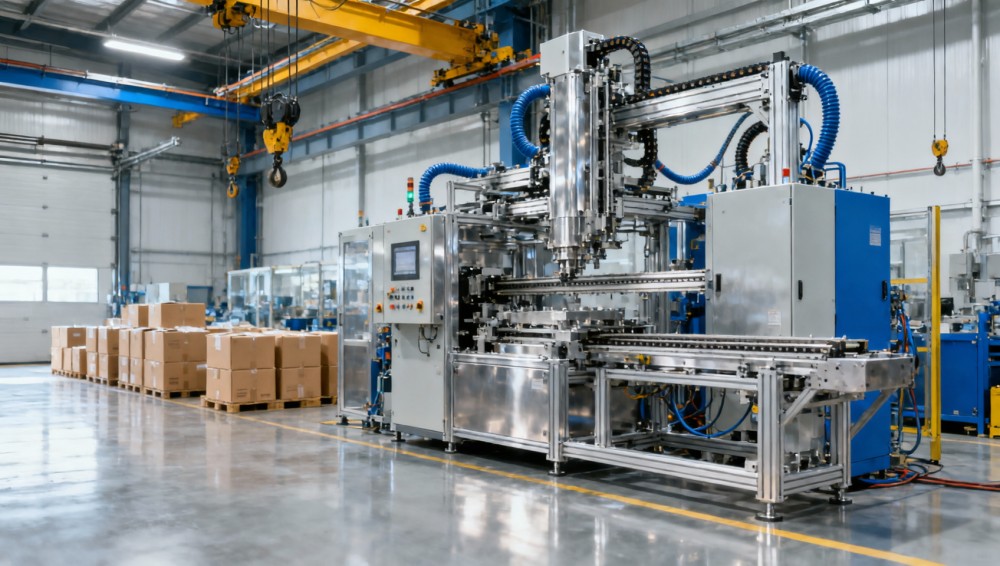
Factory acceptance testing, often referred to as FAT, deserves careful attention in custom machinery schedules. Its scope can range from a basic functional check to a structured test against agreed cycle times, material handling conditions, safety functions, documentation, and performance criteria. Some equipment can be tested with representative material at the manufacturer’s site. Others can only be partially validated before installation because the real process depends on site utilities, customer-owned materials, or connected plant equipment.
Buyers should establish early what “ready for shipment” means. Does it mean mechanical completion? Successful no-load testing? Completion of FAT punch-list items? Customer witness acceptance? Export packing after approval? Without a shared definition, a supplier and buyer may both believe they are discussing the same delivery date while using different milestones.
The same issue applies to site acceptance. Installation, energization, dry commissioning, production trials, and final site acceptance testing may happen weeks or months after shipment. For a production expansion with a fixed startup date, the schedule should be built backward from required operational readiness, not forward from purchase order placement.
International delivery can become the hidden critical path
For cross-border machinery purchases, transit time is only one part of logistics. Export packing, dimensional surveys, containerization or breakbulk planning, port handling, marine schedules, inland transport, customs clearance, insurance documentation, and local unloading capability all affect the final date. Oversized equipment requires additional coordination: route surveys, lifting plans, permits, escorts, and site access may need to be arranged before dispatch.
Import rules, tariff treatment, local electrical requirements, environmental obligations, and product-safety documentation should also be reviewed during the commercial and engineering stage. These matters may not lengthen fabrication itself, but they can delay release, installation, or operation. Requirements differ by destination and equipment type, so they should be verified against current project documentation rather than assumed from a previous order.
This is why industrial procurement teams benefit from following more than supplier updates. News on trade conditions, shipping constraints, regional energy costs, metal-market movements, infrastructure activity, industrial policy, and capacity expansion can provide useful early context. In heavy industry, project delays often emerge from conditions around the machine—not only from the machine builder’s workshop.
How to obtain a schedule that can be managed
A credible quotation should identify its schedule basis. The buyer does not need every internal production detail, but should be able to see the main gates: technical specification freeze, drawing approval, release of long-lead components, fabrication start, assembly, factory testing, packing, shipment, and expected site support. If the supplier offers a single date without conditions, it may be useful for a preliminary budget but not for construction or production planning.
The following questions tend to expose schedule risk early:
- Which components have the longest confirmed procurement cycle, and are they already allocated or merely quoted?
- What customer approvals are required before procurement and fabrication can begin?
- Which parts of the design are proven modules, and which require new engineering?
- What test criteria must be met before shipment, and who signs the acceptance record?
- What information or site conditions are needed for installation and commissioning?
- Does the delivery promise include export packing, transport, field installation, or only ex-works completion?
An approved change-control process is equally important. Buyers understandably want flexibility when process needs evolve, but changes made after drawings are released may affect purchased components, fabrication, software, testing, and transport dimensions. The real concern is not whether changes are allowed; it is whether their time and cost impact is assessed before work proceeds.
Shortening lead time without creating a later problem
The fastest way to shorten a machinery project is usually to reduce uncertainty before the purchase order, not to pressure the factory after it. A clear process specification, agreed utility data, confirmed layout, defined acceptance criteria, and prompt drawing reviews remove common sources of idle time. Selecting proven modules instead of demanding a new design for every function can also reduce engineering exposure.
There are limits. Expediting can involve premium freight, parallel fabrication, alternate components, overtime, or staged deliveries. Each option should be evaluated against performance, maintainability, spare-parts strategy, and compliance obligations. A substitution that appears harmless in procurement may create a control compatibility issue or an unwanted maintenance dependency after commissioning.
Splitting a project into early-release packages can be sensible where foundations, steelwork, cable routes, or non-critical modules can proceed before the full system is complete. It only works when interface ownership is explicit. Otherwise, the apparent schedule gain can move risk from the supplier’s factory to the installation site.
The better question is: lead time to what milestone?
When evaluating what is the typical lead time for custom manufacturing machinery orders, distinguish between order placement, design release, factory completion, shipment, arrival, mechanical installation, commissioning, and stable production. Each is a legitimate milestone, but they are not interchangeable. A project team that plans around the wrong one can discover too late that equipment “delivered” is not yet capable of producing saleable output.
For machinery serving heavy industrial value chains, procurement decisions should also account for developments beyond the quotation: raw-material conditions, component supply, trade rules, project activity, automation trends, energy constraints, and changing environmental requirements. Monitoring these signals alongside supplier schedules gives decision-makers a more realistic view of delivery risk.
The most useful next step is to convert the required startup date into a milestone plan and ask each potential supplier to respond against the same technical scope. That makes lead-time comparisons more meaningful—and makes hidden assumptions far easier to identify before they become a delay on site.