
Related News
 Are Carbon Fiber Composites Ready for Mass Use in Construction Equipment?Oct 08, 2026
- How to Verify an Industrial Supplier’s Delivery Track RecordOct 08, 2026
 What Should Buyers Do When a Key Supplier Raises Prices Mid-Contract?Oct 08, 2026
- How Do Trade Sanctions Affect Heavy-Industry Supply Chains?Oct 08, 2026




Industry Briefing
Get the top 5 industry headlines delivered to your inbox every morning.
Related News
- heavy machinery
- industrial equipment
- industrial supply
- industrial components
- machinery parts
- heavy industry
- supply chain
- procurement
- manufacturing
- procurement strategy
- supply chain resilience
- industrial supply for manufacturing
- construction machinery
- heavy equipment
- building materials
- trade requirements
- market trends
- international trade
- industrial policy
How to compare industrial supply for manufacturing vendors





Choosing the right industrial supply for manufacturing can directly affect cost control, production stability, and long-term competitiveness. For procurement professionals, comparing vendors goes beyond price—it requires evaluating quality consistency, delivery reliability, compliance, market trends, and supply chain risk. This guide outlines practical factors to help you assess manufacturing vendors more confidently and make informed sourcing decisions.
In heavy industry and related manufacturing value chains, sourcing decisions often influence not only unit cost, but also downtime exposure, inventory pressure, import-export compliance, and project execution speed. Whether you purchase steel inputs, industrial equipment, power system components, construction machinery parts, bulk materials, or plant support supplies, a structured vendor comparison process helps reduce uncertainty and improve long-term supply performance.
Define What Industrial Supply for Manufacturing Means in Your Buying Scope
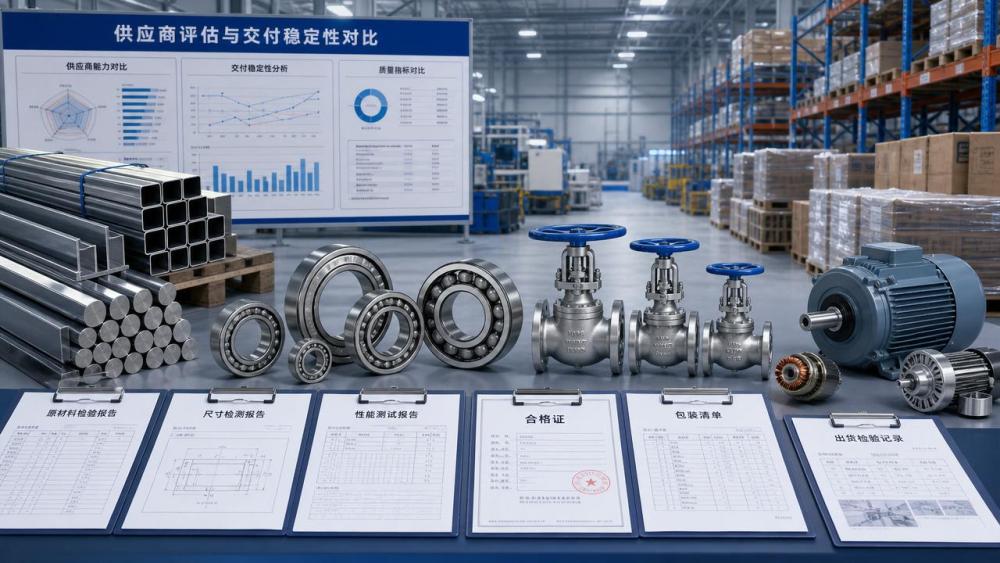
Before comparing suppliers, procurement teams should define the exact category of industrial supply for manufacturing under review. In practice, this may include raw materials, fabricated parts, industrial consumables, heavy equipment spares, motors, valves, bearings, electrical assemblies, packaging materials, or maintenance items. A vendor that performs well in one category may not be suitable in another.
A clear buying scope prevents weak comparisons. For example, sourcing plate steel with a 4–6 week lead time is very different from sourcing MRO items with a 24–72 hour delivery requirement. The evaluation criteria, acceptable substitutes, inspection methods, and risk profile all change by product type, order frequency, and plant criticality.
Start with a 4-part procurement definition
- Product specification: grade, size, tolerance, performance requirement, and application environment.
- Supply pattern: spot purchase, contract supply, scheduled replenishment, or project-based sourcing.
- Operational importance: non-critical, production-supporting, or line-stopping if delayed.
- Trade complexity: domestic sourcing, bonded trade, cross-border shipment, or tariff-sensitive import.
Why this matters for vendor comparison
If a procurement team does not define these 4 points first, suppliers may quote against different assumptions. One vendor may price based on standard export packing, another on local delivery only, while a third assumes a higher MOQ. This creates false price gaps of 5%–15% that are not actually comparable in commercial terms.
Use a Balanced Vendor Comparison Framework Instead of Price Alone
The most effective way to compare industrial supply for manufacturing vendors is to score them across multiple dimensions. In heavy industry, a low quote can quickly become expensive if the supplier misses delivery windows, fails incoming inspection, or cannot support technical documentation. A balanced framework gives procurement teams a repeatable method for shortlisting and award decisions.
A practical comparison model usually includes 6 core criteria: price, quality consistency, delivery performance, compliance, service responsiveness, and supply chain resilience. For strategic categories, many buyers also add market intelligence capability and capacity flexibility, especially where steel, energy, petrochemical, mining, or industrial equipment inputs face frequent price swings.
Recommended scoring structure for procurement teams
The table below shows a useful comparison format for industrial supply for manufacturing. It is designed for procurement managers handling medium- to high-value supply categories, where total supply performance matters more than the lowest quoted number.
The key takeaway is that price rarely deserves a 50% or higher weighting for critical manufacturing supply. For line-critical items, many buyers cap pure price weight at 30% because a single delayed batch can cost more than several months of negotiated savings.
Look at total landed cost, not just quoted cost
When comparing industrial supply for manufacturing, use landed cost as the working benchmark. This includes unit price, inland freight, customs cost, duty impact, quality inspection cost, warehousing, financing, and expected disruption cost. A supplier that is 3% cheaper on paper may become 8% more expensive after rework, late delivery penalties, and extra safety stock.
For imported categories, also check tariff changes, port congestion risk, and regional trade restrictions. In heavy industry, cross-border supply conditions can shift in 30–90 days, especially in metals, energy-linked inputs, and industrial equipment components.
Verify Quality, Compliance, and Production Fit
Quality consistency is often the biggest hidden differentiator among manufacturing vendors. Two suppliers may offer the same nominal specification, but actual performance can differ due to source variation, process control, packaging quality, or test discipline. Procurement teams should verify not only whether the product passes once, but whether it performs consistently across 6, 12, or 24 months of supply.
Key quality checks before vendor approval
- Review drawings, material specifications, and acceptance criteria line by line.
- Request sample records, inspection reports, or batch test history for 3 recent deliveries.
- Confirm packaging, marking, and traceability requirements for warehouse and shop-floor handling.
- Check whether substitute materials or process deviations require prior approval.
- Set measurable tolerance limits, such as thickness range, hardness band, pressure class, or dimensional error.
Typical risk points in industrial categories
For steel and metals, risk often centers on grade deviation, coating inconsistency, and mechanical property variation. For petrochemical or process plant items, document control and compatibility with operating temperatures can be critical. For construction machinery and heavy equipment spares, fitment, wear life, and replacement lead time may matter more than a small unit price difference.
Compliance is equally important. Procurement managers should verify whether the supplier can provide standard commercial documents, technical datasheets, packing lists, certificates of origin when needed, and any industry-specific declarations required for import, safety, or environmental review. Missing paperwork can delay customs clearance by 3–10 days or stop internal acceptance completely.
Practical approval criteria by supply type
The approval process should reflect product criticality. The table below provides a realistic framework that procurement teams can adapt when comparing industrial supply for manufacturing across heavy industry categories.
The stronger the production impact, the more rigorous the qualification should be. For non-critical consumables, a short trial may be enough. For shutdown-related or export-linked items, the vendor should pass technical, documentary, and logistics checks before full allocation.
Assess Delivery Reliability and Supply Chain Risk
A supplier that quotes competitively but delivers inconsistently is a poor fit for industrial manufacturing. Procurement teams should compare average lead time, lead time stability, shipment completeness, and response during disruption. In many factories, the difference between a 14-day reliable supplier and a 10-day unreliable supplier is more important than the headline lead time.
Questions that reveal delivery capability
- What is the normal lead time and the rush-order lead time?
- How often does the vendor ship partial orders?
- What safety stock or buffer inventory can be supported?
- Are key inputs sourced from 1 plant, 2 plants, or multiple regions?
- How are delays communicated: within 24 hours, 48 hours, or only after the committed date slips?
Common risk signals to watch
Risk increases when a supplier depends on a single upstream mill, a single export route, or a single subcontractor for machining or coating. It also rises when the vendor cannot explain capacity allocation during peak demand, lacks a backup transport plan, or provides unclear answers on raw material availability. These issues are especially relevant in steel, power equipment, mining inputs, and heavy machinery support sectors.
Procurement teams should also monitor external factors such as energy cost volatility, environmental restrictions, regional production curbs, tariff revisions, and carbon-related trade requirements. These conditions can change supplier behavior quickly, affecting both price and delivery in the next 1–2 quarters.
Build a simple risk tier model
A practical approach is to rank each vendor into 3 tiers: low risk, moderate risk, and high risk. Low-risk suppliers have stable capacity, documented lead times, and a record of responding to issues within 24 hours. Moderate-risk suppliers may be commercially attractive but need closer order planning. High-risk suppliers may still be useful for spot buys, but should not hold a large share of critical industrial supply for manufacturing.
Compare Vendor Service, Market Intelligence, and Long-Term Fit
In complex industrial markets, a supplier relationship is not just transactional. The best vendors help procurement teams anticipate change. They provide early notice of price movement, raw material shortages, regulatory shifts, and alternative sourcing options. This is particularly valuable in sectors affected by commodity cycles, international trade changes, and industrial policy adjustments.
Service factors that improve procurement performance
- Quotation accuracy and response speed, ideally within 24–48 hours for standard items.
- Ability to explain market drivers, not just send a number.
- Coordination across sales, logistics, quality, and finance teams.
- Visibility into shipment status, production schedule, and documentation readiness.
- Willingness to support forecast-based purchasing and annual contract planning.
Why industry information matters in vendor selection
For procurement professionals in heavy industry, access to timely market intelligence improves vendor comparison quality. When you understand price direction in steel and metals, energy and power trends, petrochemical input pressure, export demand changes, or policy updates affecting environmental compliance, you can judge whether a quote is reasonable and whether a supplier’s delivery promise is realistic.
This is where a professional information platform becomes useful. Ongoing coverage of industry news, regulatory updates, project activity, and supply-demand shifts helps buyers compare industrial supply for manufacturing vendors with better context. Instead of evaluating quotations in isolation, procurement teams can align buying decisions with market cycles, regional constraints, and upcoming trade risks.
A 5-Step Process to Compare Manufacturing Vendors More Effectively
A structured process reduces bias and makes supplier selection easier to defend internally. It also improves cross-functional alignment between procurement, engineering, quality, production, and finance.
Step-by-step sourcing workflow
- Define the requirement in detail, including specification, volume, delivery window, and documentation needs.
- Pre-screen 3–5 vendors based on category fit, geography, and commercial feasibility.
- Run a side-by-side comparison using weighted criteria and landed cost logic.
- Conduct a trial order, sample approval, or limited contract period of 30–90 days.
- Review performance monthly against KPIs such as on-time delivery, defect rate, and response speed.
Common mistakes to avoid
One common mistake is overemphasizing the first quotation round. Another is assuming that a well-known supplier is automatically the best fit for every plant or region. Procurement teams also lose value when they fail to update vendor comparisons after policy changes, freight shifts, or raw material volatility. In active industrial markets, a vendor ranking from 6 months ago may already be outdated.
Another frequent issue is poor internal specification control. If engineering accepts broad alternatives without clear boundaries, procurement cannot make apples-to-apples comparisons. Set clear approval rules, keep document versions aligned, and ensure every bidder prices the same scope.
Final Procurement Guidance for Better Supplier Decisions
The best way to compare industrial supply for manufacturing vendors is to combine commercial analysis with operational reality. Price matters, but so do consistency, lead time stability, compliance readiness, and the supplier’s ability to navigate changing industrial conditions. Procurement professionals who use a structured scorecard, trial orders, and market-based evaluation tend to make stronger sourcing decisions with fewer surprises.
If your team sources across steel and metals, energy and power, petrochemicals, mining, heavy equipment, building materials, or industrial support categories, timely market and policy intelligence can strengthen every vendor comparison. To improve sourcing confidence, reduce supply risk, and build a more resilient procurement strategy, get a tailored solution, consult product details, or learn more about industry intelligence support for your manufacturing supply decisions.