
Related News
 Are Carbon Fiber Composites Ready for Mass Use in Construction Equipment?Oct 08, 2026
- How to Verify an Industrial Supplier’s Delivery Track RecordOct 08, 2026
 What Should Buyers Do When a Key Supplier Raises Prices Mid-Contract?Oct 08, 2026
- How Do Trade Sanctions Affect Heavy-Industry Supply Chains?Oct 08, 2026



Industry Briefing
Get the top 5 industry headlines delivered to your inbox every morning.
High-Volume Manufacturing Techniques That Actually Cut Lead Times





For project managers and engineering leads, speed is not just a production goal—it directly affects budgets, delivery commitments, and customer trust. Understanding which high volume manufacturing techniques truly reduce bottlenecks can help teams shorten lead times without sacrificing quality or scalability. This article explores practical methods, process decisions, and operational strategies that deliver measurable gains in fast-moving industrial manufacturing environments.
Why a checklist approach works better than a theory-first discussion
In large-scale industrial production, lead time is rarely reduced by one breakthrough alone. It usually falls when teams remove waiting, stabilize throughput, simplify handoffs, and align design, sourcing, tooling, and scheduling decisions. That is why project managers should evaluate high volume manufacturing techniques through a practical checklist rather than through generic claims about automation or efficiency.
For heavy industry, equipment supply, industrial components, transport equipment, and related B2B production chains, the best high volume manufacturing techniques are the ones that cut queue time, reduce changeovers, improve repeatability, and make supply more predictable. A checklist-driven review helps teams quickly see whether a process change will improve delivery performance or simply move the bottleneck to another department.
First review: the 7 questions to answer before choosing high volume manufacturing techniques
Before investing in new production methods, engineering leads should confirm the following points. These questions prevent expensive misalignment between process capability and project delivery targets.
- What is the real source of delay: fabrication time, setup time, material availability, inspection backlog, or shipment coordination?
- Is demand stable enough to justify dedicated tooling, fixed routing, or automated handling?
- Which parts have the highest repeat volume and the lowest design volatility?
- Can upstream suppliers support shorter replenishment cycles and tighter quality consistency?
- What quality risks increase when throughput rises, especially for welding, casting, machining, coating, or assembly?
- How much lead time is spent waiting between processes rather than inside the process itself?
- Will the selected technique improve total order lead time or only machine utilization?
These checks matter because many high volume manufacturing techniques look attractive on paper but fail in practice when engineering changes, supply variability, or inspection constraints are ignored.
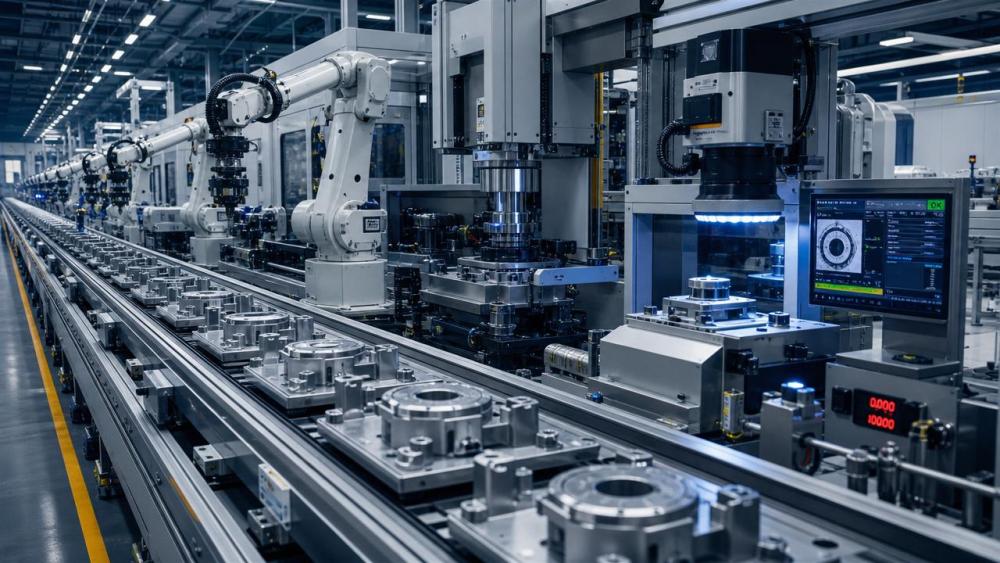
Core checklist: high volume manufacturing techniques that actually cut lead times
1. Standardized product architecture
One of the most effective high volume manufacturing techniques starts before production. Standardized interfaces, common materials, repeatable part families, and controlled variation reduce engineering release delays, simplify purchasing, and make capacity planning more reliable. For project managers, this means faster onboarding of new orders and fewer disruptions from special-case components.
Priority check: confirm whether 20% of parts create 80% of scheduling complexity. If so, design simplification may reduce lead time more than adding machines.
2. Dedicated flow lines for stable demand
When volume is high and product mix is predictable, dedicated production lines reduce waiting and routing confusion. Instead of sharing equipment across too many SKUs, a flow line supports fixed work content, balanced stations, and clearer labor planning. This is especially useful in industrial equipment, mechanical assemblies, fabricated modules, and transport subcomponents.
Judgment standard: use dedicated flow only when order patterns are stable enough to keep the line loaded without constant redesign.
3. SMED and changeover reduction
Among all high volume manufacturing techniques, reducing setup time often produces the fastest lead-time gains. Single-Minute Exchange of Die principles apply beyond stamping. They also improve fixture changes, tooling swaps, program loading, welding setup, packaging transitions, and inspection preparation. Shorter changeovers allow smaller lot sizes, faster sequence response, and less work-in-process inventory.
Execution advice: separate internal setup tasks from external preparation, pre-stage tools and materials, and standardize first-piece approval steps.
4. Cellular manufacturing for part families
Cellular layouts can outperform traditional department-based layouts when similar parts move through recurring process sequences. By placing related operations near each other, teams reduce transport, handling delays, and queue buildup between machining, deburring, inspection, and assembly. For project leaders, the main benefit is visibility: delays become easier to detect and correct.
5. Automation where labor variability causes delay
Automation is not automatically one of the best high volume manufacturing techniques. It works when cycle time is stable, quality standards are clear, and manual variability creates bottlenecks. Robotic welding, automated material handling, inline labeling, machine tending, and vision-based inspection can remove labor dependency and support round-the-clock output. However, poorly targeted automation can increase downtime and maintenance burden.
Priority check: automate repetitive delay points, not every task with high labor content.
6. Inline quality control instead of end-of-line sorting
Lead time expands when defects are discovered late. Inline gauging, poka-yoke methods, digital work instructions, torque verification, weld monitoring, and first-pass yield tracking help teams stop defects earlier. In high-volume environments, quality delay is often hidden as rework, quarantine, retesting, or customer documentation hold. Better in-process control is one of the most underrated high volume manufacturing techniques because it prevents downstream congestion.
7. Supplier synchronization and shorter replenishment loops
A factory cannot cut lead times if inbound materials remain unpredictable. Supplier scheduling windows, buffer strategies for critical raw materials, vendor-managed replenishment, dual sourcing for high-risk items, and visibility into metals, energy-linked inputs, and industrial consumables all affect production speed. In heavy industry value chains, procurement timing often determines whether high volume manufacturing techniques deliver real gains or stall at the receiving dock.
Quick evaluation table: which technique fits which situation?
What project managers should check by scenario
For new capacity expansion projects
- Validate forecast stability before committing to dedicated assets.
- Plan material flow, inspection flow, and maintenance access early.
- Confirm utility capacity, environmental compliance, and operator training lead times.
For brownfield upgrades
- Prioritize bottlenecks with the highest queue hours, not just the oldest machines.
- Check whether software, tooling, and scheduling discipline can unlock hidden capacity first.
- Assess downtime risk during installation or line conversion.
For export-oriented or globally sourced programs
High volume manufacturing techniques must be paired with trade-aware planning. Customs timing, certification documents, packaging standards, tariff shifts, and overseas customer-specific quality requirements can easily erase factory-side gains. In these cases, total lead time should be measured from raw material release to final delivery clearance, not from machine start to pack-out.
Common oversights that quietly extend lead times
Even strong production teams miss a few recurring issues. These are worth adding to every implementation review:
- Treating utilization as the main KPI while ignoring queue time and schedule adherence.
- Launching automation without spare parts strategy, troubleshooting skills, or backup routing.
- Increasing batch size to “improve efficiency,” only to create longer waiting before downstream processes.
- Overlooking inspection and documentation capacity, especially in regulated industrial sectors.
- Failing to align procurement contracts with shorter, more frequent material calls.
- Ignoring how policy changes, energy constraints, or environmental controls affect practical throughput.
Execution plan: how to apply high volume manufacturing techniques without disrupting delivery
A phased rollout usually works better than a full-scale conversion. Start with one line, one part family, or one bottleneck process. Measure baseline performance, including setup time, first-pass yield, queue time, labor hours, on-time completion, and supplier fill rate. Then apply the selected technique and compare total order lead time rather than isolated machine metrics.
Project managers should also set decision gates. If the pilot reduces throughput variation but increases maintenance stops, the team may need a reliability improvement step before scaling. If standardization lowers sourcing complexity but causes customer resistance, engineering should identify where modular customization can be preserved.
The most reliable high volume manufacturing techniques are the ones supported by cross-functional discipline: engineering change control, realistic master scheduling, supplier communication, quality ownership, and clear escalation paths when output slips.
FAQ for engineering leads and delivery owners
Which high volume manufacturing techniques give the fastest lead-time improvement?
In many factories, setup reduction, line balancing, and inline quality control deliver faster gains than large capital investments. They attack waiting time and rework directly.
When does automation not help?
Automation may not help when demand is unstable, product variation is high, maintenance support is weak, or the true bottleneck is material shortage rather than labor.
How should lead time be measured?
Measure end-to-end order lead time, queue time by operation, changeover time, rework delay, supplier replenishment time, and release-to-ship performance. This gives a more complete picture than cycle time alone.
Final action guide: what to prepare before the next process review
If your team is evaluating high volume manufacturing techniques, prepare five things first: a bottleneck map, product mix data, setup-time records, defect and rework history, and supplier reliability data. With those inputs, it becomes much easier to choose between standardization, dedicated flow, cellular layouts, automation, or changeover reduction.
If further validation is needed, project managers should prioritize discussion around required output volume, design stability, tooling readiness, quality risk, maintenance support, material lead time, budget tolerance, and implementation timing. Those questions will reveal whether a technique is truly suitable, scalable, and capable of cutting lead times in real industrial operating conditions.