
Related News
 Are Carbon Fiber Composites Ready for Mass Use in Construction Equipment?Oct 08, 2026
- How to Verify an Industrial Supplier’s Delivery Track RecordOct 08, 2026
 What Should Buyers Do When a Key Supplier Raises Prices Mid-Contract?Oct 08, 2026
- How Do Trade Sanctions Affect Heavy-Industry Supply Chains?Oct 08, 2026

Industry Briefing
Get the top 5 industry headlines delivered to your inbox every morning.
Related News
Battery Cage System of Poultry Farming: What Determines Layer Capacity





Layer capacity in a battery cage house is often treated as a simple arithmetic result: count the cages, multiply by birds per cage, and the farm’s size is defined. In practice, that number only describes installed space. The usable layer capacity of a poultry house depends on whether the birds can be stocked, managed, fed, watered, ventilated, and maintained at a density that supports stable egg production without creating avoidable health or operating problems.
For technical evaluators, the key question is not how many hens can be placed on paper, but what limits stocking density in real conditions. Cage geometry, building dimensions, manure handling, feed delivery, climate control, labor access, and pullet body size all influence where capacity should actually be set. A house that appears large enough for 20,000 layers may perform better at a lower number if aisle widths are too narrow, heat removal is inadequate, or manure belts cannot keep pace with output.
Installed capacity and operating capacity are not the same
Suppliers and buyers sometimes use “capacity” in different ways. Installed capacity refers to the total number of birds that the cage rows can physically hold. Operating capacity is the number the farm can sustain while keeping feed access, water availability, air quality, flock inspection, manure removal, and egg collection within acceptable limits.
The difference matters during project evaluation. If a layout is built around the maximum possible cage count but the building envelope, fan placement, or manure discharge system is undersized, the system may become harder to run during hot weather or at peak production. Technical review should therefore start with a simple discipline: every bird added to the cage line increases demand on the entire house, not only on the wire compartment that holds the bird.
Cage dimensions set the first practical limit
The most immediate determinant of layer capacity is the usable area available to each bird. That sounds obvious, but buyers often focus on the number of tiers and rows while paying less attention to cage depth, width, partition design, and feeder and drinker placement. Birds do not use every square centimeter equally. Dead corners, poor door placement, excessive slope toward the egg trough, or poorly positioned nipple lines can reduce effective living space even if nominal cage dimensions look acceptable.
Stocking decisions should reflect the strain of hen, target body weight, and production stage. A light commercial layer at an early stage places different demands on the cage than a heavier bird later in the cycle. If body size increases but cage occupancy remains fixed, access to feed trough space and drinkers can become more competitive. That may not appear immediately as mortality, but it can show up as uneven flock condition, variable egg size, and more stress during hot periods.
Technical evaluators should ask for the actual cage compartment dimensions, not just the total house capacity. They should also review how many birds share one nipple, how much linear feeder space is available per bird, and whether cage partitions support uniform distribution of birds within the compartment.
Tier count increases density, but also increases system load
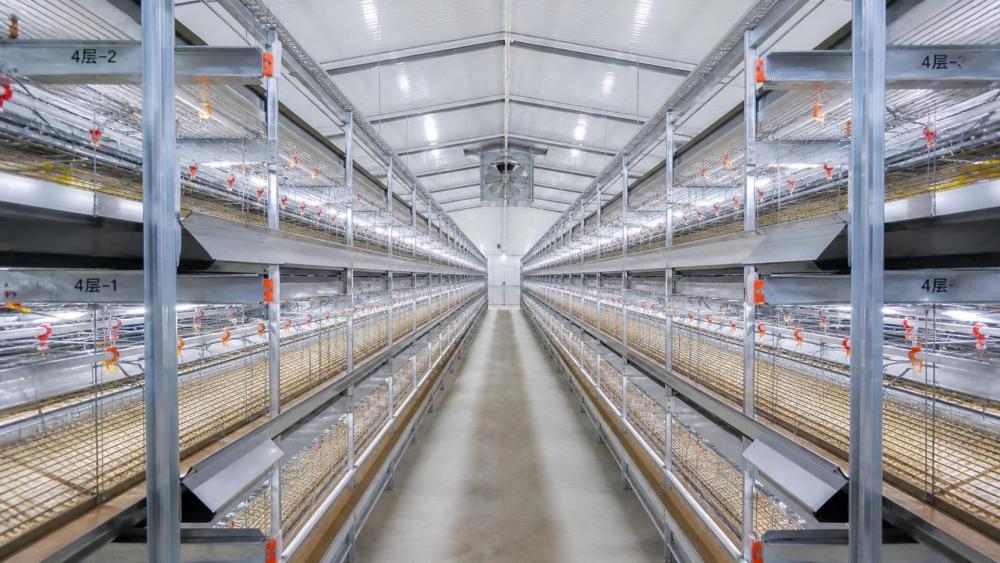
Multi-tier A-type or H-type arrangements can significantly expand capacity within a fixed building footprint. Yet every additional tier raises technical demands. Higher density means more body heat, more moisture from respiration, more manure volume, and more dependence on reliable automation. A five-tier arrangement may look attractive in a cost-per-bird comparison, but it is less forgiving if ventilation design, power backup, or maintenance routines are weak.
When assessing a battery cage system of poultry farming, buyers usually need to go beyond the cage frame itself and check how the full housing package supports the intended bird count. If the system is presented as an automatic A-type layer setup, the relevant question is whether the feeder, drinker, manure cleaning, and egg collection functions are sized to the same operational capacity as the cage rows, rather than to a lower practical ceiling.
Higher tiers also affect inspection and handling. Birds on upper levels are harder to observe closely, and service access becomes more important when identifying sick birds, repairing drinker leaks, or removing mortality. If routine inspection is compromised, the apparent capacity advantage can be offset by weaker flock control.
Building geometry often determines the real ceiling
Two farms can install a similar number of cages but achieve different working capacities because the house dimensions are different. Length, width, sidewall height, roof profile, and aisle allocation all shape the effectiveness of the system.
A narrow building with insufficient central aisle space may restrict movement of workers, feed distribution components, or egg collection maintenance. A low roof can reduce heat accumulation volume and make summer ventilation less stable. If end-wall space is limited, fans and inlets may be installed in a compromised arrangement, which then affects air speed and fresh-air distribution across cage tiers.
Technical assessments should examine these points together:
- clear aisle width for inspection, repairs, and bird handling;
- distance between cage rows and sidewalls;
- space reserved for manure discharge and equipment service;
- headroom above the top tier for air movement and access;
- structural loading capacity of the floor and support points.
A house that is dimensionally tight can still carry a large installed cage count, but operating margins become narrow. Small errors in installation or seasonal management then have larger effects on flock comfort.
Ventilation and thermal control usually define capacity in warm climates
In many layer projects, the strongest limit on capacity is not cage count but the house’s ability to remove heat, moisture, dust, and gases. Layers generate a continuous heat load. As density rises, the ventilation system must keep indoor conditions within a range that supports feed intake and egg production. If airflow is uneven, birds on certain tiers or at certain sections of the house may experience chronic stress even when average house readings seem acceptable.
This is why capacity must be evaluated seasonally. A house that performs acceptably during mild weather may become overstocked during hot months. Heat stress reduces feed consumption, and egg output can decline before obvious emergency symptoms appear. At the same time, ammonia levels may rise if manure drying is poor, especially in systems where belt cleaning intervals are too long or building airflow does not support moisture removal.
For technical reviewers, a credible capacity estimate should be tied to climate assumptions. The supplier’s layout might physically hold a certain number of layers, but the buyer should confirm whether that number assumes open-sided housing, closed housing, tunnel ventilation, evaporative cooling, or another environmental control strategy.
Manure handling capacity is easy to underestimate
Every increase in hen numbers creates a proportional increase in manure volume and moisture burden. If manure belts, scrapers, pits, or discharge points are undersized, the problem goes beyond sanitation. Wet manure raises ammonia, attracts flies, increases corrosion risk, and can make worker access less safe. Capacity planning should therefore include cleaning frequency, belt speed, discharge logistics, and storage arrangements outside the house.
In cage projects with automatic manure removal, buyers should verify whether the removal schedule fits local labor and waste-handling practice. A technically adequate belt system inside the building can still become a bottleneck if transport out of the house is inconsistent. This is one reason nominal capacity and dependable capacity diverge on some farms.
Feed and water access affect flock uniformity, not just survival
A cage house does not fail only when birds run out of feed or water. More often, poor distribution shows up as uneven body condition and inconsistent laying performance. Feed chain capacity, trough level adjustment, nipple pressure, flushing ability, and header tank stability all influence how many birds a cage line can carry without sacrificing flock uniformity.
At higher stocking rates, small distribution problems become larger. If feed reaches one end of the house later than the other, aggressive birds may dominate access. If pressure variation causes weak nipple flow on upper levels, some birds may chronically underconsume water. These are not minor details for technical evaluators; they directly shape whether the projected layer capacity is workable.
Bird strain, management style, and replacement cycle also matter
Capacity cannot be determined by equipment alone because the birds and the management system change the equation. Different layer strains vary in body size, temperament, and response to heat. A farm aiming for longer production cycles may need to preserve more space per bird later in life. Farms with highly disciplined inspection, preventive maintenance, and pullet transfer procedures can often run closer to design limits than farms with weaker routine control.
The source and uniformity of pullets should also be considered. If incoming birds vary widely in body weight, competition within cage compartments can intensify. That may push the practical occupancy target lower than the supplier’s standard configuration would suggest.
Material and construction details influence how much capacity remains usable over time
A newly installed system may meet its layout target, but long-term capacity depends on how well the cage structure resists corrosion, deformation, and wear. Wire diameter, galvanization method, weld quality, frame rigidity, and anti-rust treatment affect the service condition of floors, partitions, doors, trough supports, and manure components.
This matters because degraded cages reduce usable capacity in a gradual way. Broken wires increase foot injuries and egg breakage. Bent doors make bird handling slower. Corroded supports can interfere with feed alignment or manure belt tracking. Technical buyers should review construction details alongside capacity claims, especially where humidity, saline air, or aggressive cleaning conditions are expected.
Procurement review should test the system, not only the quotation
For buyers comparing offers, a low cost per bird can hide mismatches between cage count and supporting infrastructure. A sound technical review usually checks the following before approval:
- whether listed capacity refers to birds per cage, birds per house, or birds per project;
- whether feeder, drinker, egg collection, and manure removal capacities are stated consistently;
- whether house drawings show realistic aisle and service clearances;
- whether installation tolerances and floor level requirements are defined;
- whether spare parts and maintenance points are identified for automatic components;
- whether local climate, power stability, and labor skill were considered in the design basis.
It is also useful to ask how the supplier expects capacity to be adjusted if the farm changes bird strain, extends laying cycles, or upgrades ventilation later. Flexible layouts can preserve decision options that a tightly packed initial design may remove.
Where buyers often misjudge layer capacity
One common mistake is treating all cages with the same nominal footprint as equivalent. In reality, cage floor slope, partition shape, trough access, and serviceability can produce different outcomes at the same bird count. Another is evaluating capacity without matching it to the hottest season. A third is assuming automation eliminates labor constraints; in fact, automation reduces routine workload but raises the importance of maintenance discipline and backup planning.
Technical evaluators should also be careful with future expansion assumptions. If a house is initially stocked below its maximum cage count, the missing capacity is not automatically available later. Expansion may require stronger ventilation, more manure handling frequency, revised biosecurity flow, or additional standby power.
Capacity is a systems decision
The practical layer capacity of a battery cage installation is set by the narrowest technical margin in the whole house. Sometimes that is cage floor area. In other cases it is summer ventilation, manure drying, drinker performance, or access for inspection and maintenance. The right capacity figure is the highest bird number the building can support repeatedly without pushing any critical subsystem into chronic stress.
For poultry farm buyers and technical reviewers, that makes capacity less of a catalog number and more of a design judgement. A reliable evaluation links cage dimensions, bird size, house geometry, environmental control, manure logistics, feed and water delivery, and long-term durability. When those factors are checked together, the final stocking decision is usually more conservative than the headline maximum, but far more useful in day-to-day layer production.