
Related News
 Are Carbon Fiber Composites Ready for Mass Use in Construction Equipment?Oct 08, 2026
- How to Verify an Industrial Supplier’s Delivery Track RecordOct 08, 2026
 What Should Buyers Do When a Key Supplier Raises Prices Mid-Contract?Oct 08, 2026
- How Do Trade Sanctions Affect Heavy-Industry Supply Chains?Oct 08, 2026
Industry Briefing
Get the top 5 industry headlines delivered to your inbox every morning.
How to Compare Filtration Systems Units for Dust and Fume Control





Comparing filtration systems units for dust and fume control is rarely a simple equipment exercise. In heavy industry, the right decision affects worker exposure, line uptime, energy use, permit compliance, and even cross-border project viability.
That is why airflow numbers alone do not tell the full story. A useful comparison looks at how each unit performs under real process conditions, how stable it remains over time, and what it will cost to operate through its service life.
What needs to be compared first
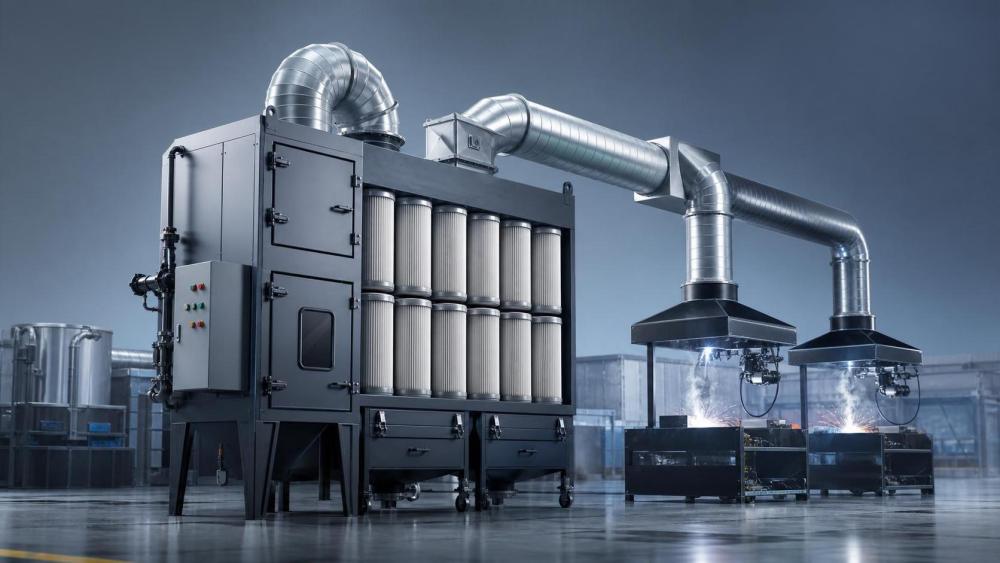
At a basic level, filtration systems units are designed to capture airborne contaminants before they spread through a workspace or exhaust stack.
Yet dust and fume behave very differently. Dry mineral dust, oily welding fume, combustible particles, and corrosive mist each place different demands on a collection system.
A strong comparison starts by defining the contaminant profile:
- Particle size distribution
- Dust loading concentration
- Temperature and humidity
- Chemical reactivity or corrosiveness
- Explosion or fire risk
- Required capture and emission limits
Without that baseline, two filtration systems units may look similar on paper while performing very differently in practice.
Why the issue matters more now
Across steel, mining, cement, power, foundry, fabrication, and petrochemical operations, dust and fume control is becoming a sharper business variable.
Environmental rules are tightening in many regions. Carbon frameworks, workplace exposure standards, and local air permits are moving closer to daily operating decisions.
At the same time, project teams are watching equipment costs, imported component lead times, and replacement filter availability more closely.
That broader context matters. Industrial news, policy tracking, trade updates, and equipment pricing trends now shape how filtration systems units are specified and approved.
A unit that meets today’s process need but depends on unstable supply chains or uncertain compliance assumptions may become a weak choice later.
Performance should be judged at the source
Many evaluations focus too much on collector capacity and too little on capture effectiveness.
For dust and fume control, source capture often decides whether the system actually works. Hood design, enclosure quality, duct routing, and face velocity all matter before air even reaches the filters.
This is especially important in applications such as:
- Electric arc furnace and ladle treatment areas
- Thermal cutting and robotic welding cells
- Crushing, screening, and transfer points
- Bagging, mixing, and powder handling lines
- Battery, chemical, and coating operations
If a supplier compares filtration systems units without discussing upstream capture conditions, the evaluation is incomplete.
Efficiency is not a single number
Filter efficiency claims can be misleading when taken out of context. A high nominal rating does not automatically guarantee better field performance.
More useful questions include how efficiency changes as filters load, how the cleaning system performs, and whether fine particles pass through during pressure swings.
For many filtration systems units, stable performance over time matters more than peak laboratory efficiency.
Operating conditions change the right answer
A unit that fits a dry indoor process may fail quickly in a hot, sticky, abrasive, or moisture-heavy environment.
That is why comparisons should include operating reality, not only rated conditions.
This is often where one filtration systems units option separates from another. The better design usually reflects the process, not just the catalog.
Compliance, reporting, and project risk
Dust and fume control now sits closer to regulatory scrutiny than many equipment categories.
Emission thresholds, workplace limits, local discharge permits, and fire safety codes may all influence equipment selection.
In export-oriented projects, trade rules and customer standards can add another layer. Documentation quality, traceability, and conformity records sometimes matter as much as hardware configuration.
When comparing filtration systems units, check whether the supplier can support:
- Applicable emission and safety standards
- Performance test records
- Filter media certifications
- Inspection and maintenance documentation
- Local permitting or commissioning support
This reduces the risk of later redesign, delayed startup, or non-compliant operation.
Lifecycle cost is usually more important than purchase price
Two filtration systems units with similar capital cost can produce very different long-term economics.
Energy demand is one major driver. Pressure drop, fan efficiency, cleaning frequency, and air volume control all affect operating cost year after year.
Filter replacement is another. Media life, ease of access, shutdown duration, and spare part availability should all be included in the comparison.
In practical terms, a lower-priced unit may become expensive if it requires frequent media change, compressed air overuse, or repeated unscheduled cleaning.
Questions that expose hidden cost
- What is the expected pressure drop over a normal cycle?
- How often are filters replaced in similar duty conditions?
- What consumables depend on imported supply?
- How long is a typical maintenance stop?
- Can key parts be sourced regionally?
These questions become more relevant when industrial equipment prices and shipping conditions are changing quickly.
Technology differences that deserve closer attention
Not all filtration systems units use the same collection logic. Bag filters, cartridge collectors, wet scrubbers, electrostatic approaches, and hybrid systems each suit different contaminants.
Cartridge systems may work well for fine dry particulate with compact footprints. Baghouses often handle higher dust loads and harsher industrial duty. Wet systems can help where sparks, sticky particulate, or soluble fumes complicate dry collection.
More recent upgrades include sensor-based monitoring, automated differential pressure control, predictive maintenance signals, and integration with plant automation.
Those features are not automatically decisive, but they can improve visibility, especially in large plants running multiple filtration systems units across different lines.
A practical comparison framework
A disciplined review process helps turn supplier data into an actionable decision.
One useful approach is to score each option across a limited set of weighted criteria:
- Capture effectiveness at the source
- Suitability for actual dust or fume characteristics
- Compliance and safety alignment
- Energy and maintenance burden
- Installation constraints and retrofit fit
- Spare parts, service network, and documentation quality
- Total lifecycle cost under expected duty
This method is especially useful when tracking equipment bids across regions, or when market, policy, and supply chain conditions are shifting at the same time.
Before making a final choice, align process data, regulatory requirements, maintenance assumptions, and commercial terms in one comparison sheet. That creates a clearer basis for selecting filtration systems units that will remain workable after installation, not just at approval stage.