
Related News
 Color Coated Steel Selection: Substrate, Coating and Service LifeNov 07, 2026
- US Refiners Shift Output From Gasoline to Middle DistillatesNov 06, 2026
- China's Steel Output Falls 2.9% in 2026 as Industry Shifts to High-Performance SteelNov 05, 2026
- China Tightens Technology Export Controls on Tunnel Boring Machines and DronesNov 04, 2026

Industry Briefing
Get the top 5 industry headlines delivered to your inbox every morning.
Construction Equipment Market Outlook: Demand Drivers, Price Pressure, and Sourcing Risks





The construction equipment market is moving through a more layered cycle than many buyers expected a year ago. Demand still has support from infrastructure spending, energy transition projects, mining investment, and urban redevelopment, yet pricing is harder to read and sourcing decisions carry more risk. In this setting, market signals from steel, power, freight, policy, and trade rules matter almost as much as equipment specifications. A clear view of these linked factors helps turn a broad market outlook into practical timing, supplier, and cost decisions.
Why the construction equipment market remains active
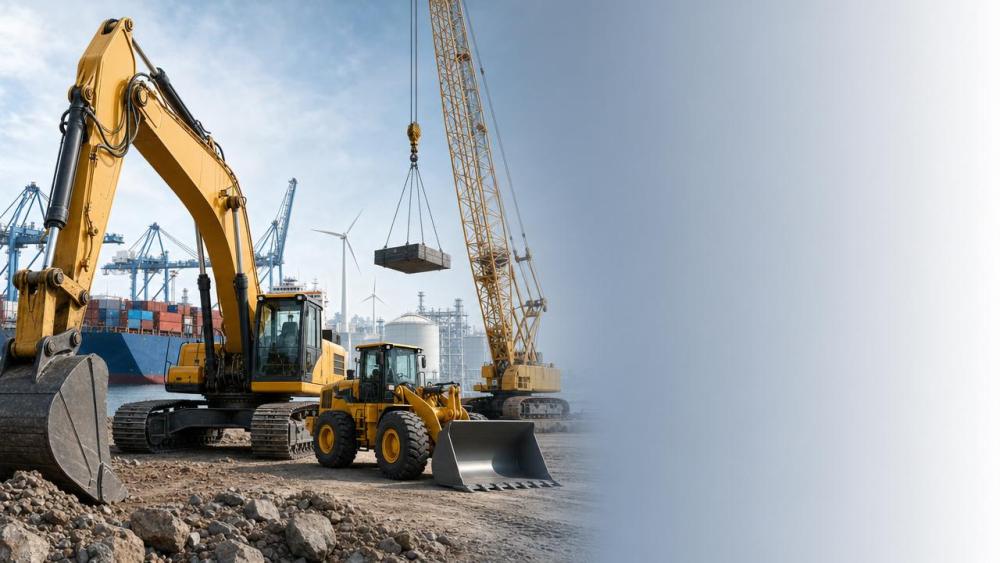
Equipment demand is no longer driven by one single construction cycle. It now reflects several industrial tracks that move at different speeds.
Large public infrastructure programs continue to support excavators, loaders, cranes, concrete equipment, and road machinery in many regions.
At the same time, power grid projects, renewable energy facilities, ports, logistics corridors, and mining sites create demand for specialized heavy equipment.
This matters because the construction equipment market is no longer tied only to commercial building activity. It is increasingly connected to broader heavy industry investment.
That connection is important when assessing market direction. Steel output, diesel costs, cement demand, quarry activity, and public budget priorities often provide early clues.
In other words, equipment demand should be read through upstream and downstream value chains, not through unit sales alone.
What is shaping demand in the current cycle
Several demand drivers are supporting the construction equipment market, but they do not always move in the same direction.
Infrastructure and public works
Road building, water management, rail, airport upgrades, and municipal works still anchor baseline demand in many countries.
These projects often favor medium and heavy machines, especially where governments prioritize resilience, transport efficiency, or industrial capacity expansion.
Energy and resource investment
Mining, quarrying, transmission lines, utility-scale solar, wind foundations, and oil and gas maintenance all support equipment use beyond traditional building sites.
For the construction equipment market, this creates a more diversified demand base, although project schedules can be sensitive to commodity prices.
Fleet renewal and equipment modernization
Older fleets are being replaced due to fuel costs, emissions rules, maintenance burdens, and the need for telematics or automated controls.
This supports demand even when new greenfield construction slows. It also shifts attention from sticker price to lifetime operating economics.
Financing conditions
Interest rates and credit access still shape purchasing behavior. Higher funding costs can delay purchases, increase rental use, or shift demand toward lower-priced brands.
As a result, equipment demand may remain present while order conversion becomes slower and more selective.
Price pressure is coming from more than one side
The construction equipment market is facing price pressure from inputs, production, logistics, and competition at the same time.
Steel remains one of the most visible variables. Even modest changes in plate, structural steel, or specialty components can affect machine costs.
Power prices, fuel expenses, tires, hydraulics, electronics, and freight rates also influence equipment pricing, especially for globally sourced models.
Yet cost inflation does not always lead to higher selling prices. In some segments, competitive pressure is strong enough to compress margins instead.
Manufacturers may respond through localized production, supplier renegotiation, platform standardization, or feature bundling rather than headline price increases.
That makes list price a weak indicator on its own. Total delivered cost, warranty scope, spare parts availability, and service response often matter more.
Sourcing risks are becoming a strategic issue
For many businesses, the real challenge in the construction equipment market is not demand alone. It is supply reliability under changing trade and policy conditions.
Cross-border sourcing now involves tariff exposure, local certification requirements, emissions compliance, sanctions screening, and currency volatility.
A machine that appears competitively priced can become less attractive after freight adjustments, customs delays, or documentation issues.
Spare parts risk is equally important. Delivery delays on filters, pumps, seals, controllers, and undercarriage components can disrupt project schedules more than initial purchase price differences.
There is also a growing divide between visible and hidden supplier strength. Some suppliers offer aggressive pricing but depend on fragile sub-tier networks.
That is why regular tracking of corporate news, production expansion, partnership changes, and order delivery performance has become commercially relevant.
Where sourcing risk usually appears first
- Lead times stretch for imported engines, transmissions, chips, and hydraulic systems.
- Compliance rules change faster than contract terms.
- Dealer service capacity lags behind sales growth.
- Exchange rate swings distort budget assumptions.
- Regional conflicts or trade actions interrupt normal shipping routes.
How to read the construction equipment market in practice
A useful market view combines product signals with broader industrial intelligence. This is where heavy industry coverage becomes practical rather than theoretical.
Price monitoring in steel, energy, and freight can indicate cost direction before OEM quotations change.
Policy and regulatory updates can signal future demand shifts, especially where public works budgets, emissions standards, or import rules are changing.
Project tracking also helps. New mines, industrial parks, logistics hubs, and power projects often translate into localized equipment demand ahead of general market reports.
Technology coverage matters as well. Electrification, telematics, energy-saving systems, and automation features can alter equipment selection and residual value expectations.
Seen this way, the construction equipment market is best understood as part of a broader industrial ecosystem rather than a standalone sales category.
Key evaluation angles across regions and segments
Not every region is moving in the same pattern. Some markets show strong project pipelines but weaker financing. Others show stable demand but tighter import controls.
The same is true by product segment. Earthmoving, lifting, road machinery, concrete systems, and mining equipment each respond to different investment cycles.
A practical comparison framework can reduce noise.
What deserves closer attention next
The near-term outlook for the construction equipment market is less about a single global direction and more about selective opportunity.
Markets tied to infrastructure, energy systems, mining, and industrial relocation may outperform broader construction sentiment.
At the same time, price pressure is unlikely to disappear quickly, especially where financing remains expensive and suppliers compete for share.
That makes disciplined tracking essential. Watch policy shifts, raw material movements, shipment reliability, and supplier operating signals together rather than in isolation.
For the next step, it is useful to map equipment demand against project exposure, compare delivered cost rather than quoted price, and maintain a live watchlist of trade, compliance, and supplier changes.
A stronger decision framework usually begins there: with better signals, better timing, and a more realistic reading of the construction equipment market.