
Related News
 Are Carbon Fiber Composites Ready for Mass Use in Construction Equipment?Oct 08, 2026
- How to Verify an Industrial Supplier’s Delivery Track RecordOct 08, 2026
 What Should Buyers Do When a Key Supplier Raises Prices Mid-Contract?Oct 08, 2026
- How Do Trade Sanctions Affect Heavy-Industry Supply Chains?Oct 08, 2026
Industry Briefing
Get the top 5 industry headlines delivered to your inbox every morning.
Related News
What to Check Before Sourcing a YLCSD350 Cutter Suction Dredger for Projects





Project fit matters more than the model name
Procurement teams usually get into trouble with dredger sourcing when they start from the machine label instead of the job conditions. A YLCSD350 class cutter suction dredger may suit many mining ponds, river maintenance works, and canal rehabilitation jobs, but only if its hydraulic, structural, and operational profile matches the material to be cut, the pumping distance, the water depth, and the logistics of the site.
That is why the first review should not be the brochure. It should be the project brief: required production target, soil profile, disposal route, working season, available power, assembly constraints, and how often the dredger must be moved. For buyers handling mining and waterway projects, those inputs have a direct effect on whether a dredger will perform steadily or become a high-cost bottleneck after delivery.
A sourcing decision in this category is rarely about one number. Cutter power without enough pump performance creates a mismatch. A strong pump without wear protection may raise maintenance cost in abrasive slurry. Easy shipment on paper can still become difficult if the site has narrow access roads, shallow launching points, or limited crane capacity. The practical question is not whether a dredger can dredge, but whether it can sustain the planned output under the real conditions of the project.
Start with the material, not the headline capacity
Mining and waterway dredging often get grouped together, yet the material behavior can be very different. A buyer should ask what the dredger is expected to cut and transport on a daily basis:
- Loose silt or soft clay in channels
- Compacted clay layers in maintenance basins
- Sand and fine gravel in aggregate or mining applications
- Material with shells, debris, roots, or occasional stones
These conditions affect cutter head configuration, installed power, pump selection, pipe wear, and expected downtime. In waterway projects, the challenge is often stable production with variable sediment and limited interruption to navigation. In mining ponds or tailings areas, slurry density, abrasion, and longer discharge routes may become the critical issue.
If the supplier only asks for dredging depth and hourly output, that is not enough. Procurement teams should expect a more detailed technical discussion covering particle size, in-situ density, expected solids concentration, and how material changes across the working area. A dredger that looks adequate in average conditions may struggle in the hardest sections of the site, which is where projects often lose time.
Check whether the hydraulic system matches the discharge route
Many sourcing errors come from underestimating the discharge line. Cutter suction dredgers are not judged only by excavation ability; their real job is to move slurry through a hydraulic system with unavoidable friction losses. Buyers should verify:
- Total discharge distance, including floating and land pipeline
- Static lift and elevation changes
- Expected bends, valves, and connection losses
- Required solids concentration at the discharge point
- Whether a booster station may be needed later
A dredger sized mainly for excavation can become inefficient if the project has a long disposal corridor. In mining applications, where material may need to be pumped to a remote stockpile or process area, this issue becomes even more important. In waterway maintenance, shorter distances may appear easier, but narrow corridors, temporary crossings, or restricted routing can still add pressure loss and operational complexity.
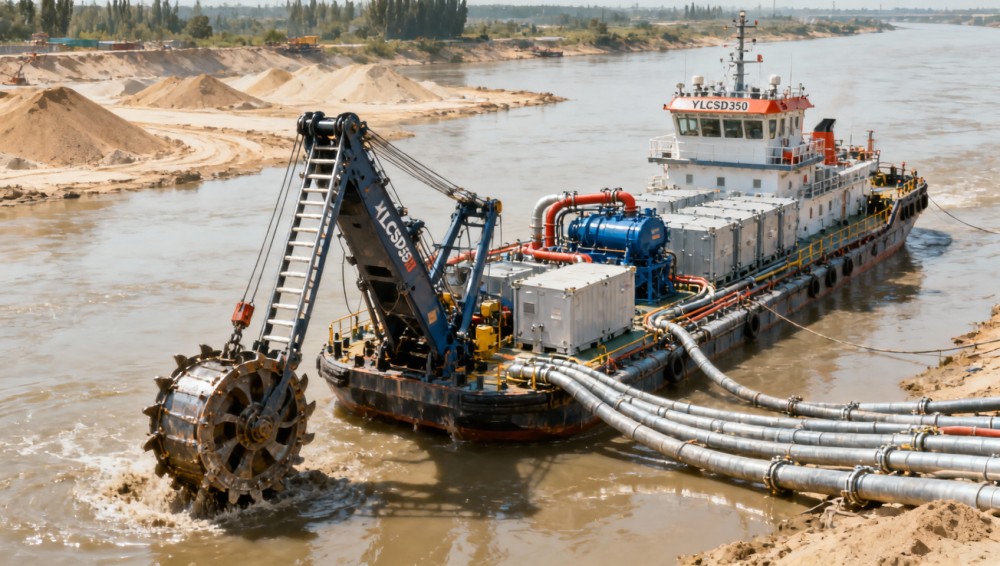
When reviewing a YLCSD350 cutter suction dredger, buyers should focus on the hydraulic balance between the dredge pump, suction side arrangement, cutter working range, and projected pipe system rather than relying on one nominal output figure. That is often the difference between realistic production planning and a machine that performs well only in ideal conditions.
Look closely at cutter power, ladder design, and digging geometry
The cutter side of the machine determines whether material can be loosened consistently enough for the pump to work at an efficient slurry concentration. Procurement teams should request details on cutter drive type, power transmission, cutter head design, ladder strength, and the practical digging depth range.
What matters in the field is not simply maximum digging depth on a specification sheet. The more useful questions are these:
- Can the ladder maintain stable cutting angles in the planned depth range?
- Will the cutter keep feeding material evenly in denser layers?
- Is the structure robust enough for repeated duty in abrasive or partially compacted ground?
- How easy is it to inspect and replace wear parts around the cutter area?
Mining projects typically punish wear components faster than light desilting work. If the supplier cannot clearly explain wear protection strategy for the cutter, pump casing, impeller, and pipeline, the total operating cost may be understated at the procurement stage.
Transport, assembly, and relocation can reshape the total cost
Buyers often compare only purchase price and expected output, yet assembly and relocation can materially change project economics. A dredger used on one long-term site can be evaluated differently from one that must be disassembled and moved between contracts.
Before issuing or accepting a quotation, procurement teams should check:
- Transport dimensions of pontoons and major modules
- Whether local roads, bridges, and port facilities can handle the loads
- Assembly method at site and the lifting equipment required
- Time needed from delivery to commissioning
- How quickly the unit can be shifted to another section or future project
This is especially relevant in waterway works where access may be constrained by embankments, temporary jetties, or seasonal water levels. In inland mining areas, overland transport and launch preparation can become the main schedule risk. A lower purchase price may lose its advantage if mobilization requires heavy support equipment that is hard to source locally.
Confirm the wear package and maintenance access
For procurement personnel, maintenance planning is not an afterthought; it is part of capacity assurance. Abrasive slurry can quickly affect liners, impellers, cutter teeth, suction components, and discharge pipes. Two dredgers with similar nominal performance can have very different maintenance burdens depending on material selection and serviceability.
Useful checks include:
- Which high-wear parts are replaceable and how they are fixed
- Expected access time for routine inspection
- Availability of spare parts lists for commissioning stock and operating stock
- Whether standard wear items can be changed on site without major dismantling
- Protection measures for pump and pipeline components in abrasive service
Ask for a practical spare parts recommendation tied to the first operating period, not a generic list. A supplier that understands mining and waterway applications should be able to discuss which parts are likely to wear faster under different sediment conditions and how operators can monitor that wear before failure interrupts production.
Review power configuration and local operating constraints
The right power arrangement depends on where the dredger will work and what support infrastructure exists around it. If the site has limited fuel supply, weak local service support, or restrictions on emissions and noise, those conditions can influence engine selection, auxiliary systems, and maintenance planning.
Procurement teams should clarify:
- Main and auxiliary power requirements during normal dredging
- Fuel consumption under expected duty, not only at rated output
- Cooling suitability for local water and ambient temperature conditions
- Availability of replacement filters, seals, and engine service support
- Electrical system compatibility with local instrumentation and controls practice
In remote mining areas, equipment uptime often depends as much on supportability as on initial build quality. In busy waterways, stable control response and dependable auxiliary systems may matter more because unplanned stoppages can interfere with work windows and vessel traffic management.
Do not treat automation and controls as optional extras
A cutter suction dredger may be mechanically sound but still hard to operate efficiently if the control system offers limited visibility into production conditions. Buyers should assess what information the operator can actually use in real time: pump speed, vacuum and pressure readings, ladder position, cutter load, swing status, and alarm management.
For procurement, the issue is not sophistication for its own sake. Better instrumentation helps operators avoid overload, dry running, unstable slurry concentration, and avoidable wear. It also improves acceptance testing because production discussions can be tied to actual operating data rather than guesswork.
If a project involves multiple shifts, variable sediment layers, or a contractor team that may change over time, clear controls and readable monitoring interfaces become a risk-control measure. Poor instrumentation tends to surface later as inconsistent output and hard-to-diagnose maintenance issues.
Inspect documentation the same way you inspect steelwork
Many buyers give strong attention to visible fabrication quality but less attention to technical documents. That is a mistake, because documentation affects installation, commissioning, maintenance, spare parts ordering, and later dispute resolution.
The review package should typically include:
- General arrangement drawings
- Main equipment list
- Pump and cutter technical details
- Pipeline and auxiliary system information
- Operating and maintenance manuals
- Commissioning and inspection records where applicable
Even when the procurement is not subject to a complex formal standard package, the buyer should still confirm that the document set is complete enough for practical operation. If the operating team cannot quickly identify service intervals, wear parts, lubrication points, or hydraulic layout, the machine may become harder to run safely and economically.
Factory inspection should focus on risk points, not appearance alone
A pre-delivery inspection is more useful when tied to likely failure points. Attractive paint and a clean deck tell very little about whether the dredger will hold up under abrasive service. Procurement teams or their inspectors should pay closer attention to weld quality in loaded areas, alignment of rotating assemblies, accessibility of maintenance points, pipe support arrangement, sealing details, and consistency between drawings and the actual build.
Functional checks matter as well. Where feasible, witness testing of pump rotation, cutter movement, winch response, hydraulic actions, and control logic can reveal issues that are expensive to correct after shipment. The goal is not to create a perfect machine before delivery; it is to catch defects that are difficult to remedy once the dredger is mobilized to a remote site.
Build acceptance criteria around the actual project
One of the most practical steps in sourcing is to define what acceptance means before production begins. A generic statement that the dredger must “meet performance requirements” leaves too much room for disagreement. Procurement teams should align internal stakeholders on measurable items such as assembly completeness, key component verification, operating checks, spare parts scope, and any agreed test conditions.
For mining projects, acceptance may need stronger attention to wear protection and sustained slurry handling. For waterway projects, maneuverability, shallow-water operability, and set-up efficiency may deserve more weight. The same dredger model can be judged differently depending on which risk is more costly on site: lost production, excessive wear, difficult mobilization, or operational interruption.
What separates a workable purchase from an expensive mismatch
The strongest sourcing decisions come from connecting the dredger to the project system around it: material, discharge route, site access, maintenance plan, support conditions, and acceptance method. Buyers who only compare quoted capacity and price often miss the real cost drivers. Buyers who test the machine against the hardest operating conditions usually make better long-term decisions.
For a YLCSD350 cutter suction dredger, the key checks are less about headline claims and more about fit: whether the hydraulic design supports the pipeline plan, whether the cutter and ladder can handle the actual soil, whether wear exposure has been considered honestly, and whether the unit can be transported, assembled, and maintained within the project’s constraints. Those are the details that determine whether the dredger becomes productive equipment or a contract risk.