
Related News
 US Refiners Shift Output From Gasoline to Middle DistillatesNov 06, 2026
- China's Steel Output Falls 2.9% in 2026 as Industry Shifts to High-Performance SteelNov 05, 2026
- China Tightens Technology Export Controls on Tunnel Boring Machines and DronesNov 04, 2026
- World Steel Association Issues Climate Change and Steel Production Position PaperNov 02, 2026


Industry Briefing
Get the top 5 industry headlines delivered to your inbox every morning.
Related News
Documentation and Test Runs That Reduce Risk in Used Extruder Purchases





Why the Paper Trail Matters Before a Used Extruder Changes Hands
A used plastic extruder can look serviceable during a warehouse inspection and still create costly problems after installation. The risk is not limited to obvious wear on the screw, barrel, gearbox, or heaters. A buyer may inherit unclear electrical modifications, incompatible controls, missing safety devices, undocumented repairs, or a machine configuration that does not match the intended resin and product.
For procurement teams, the central question is not simply whether the equipment can run. It is whether the extruder can be accepted with a defensible understanding of its condition, capabilities, remaining uncertainties, and commissioning requirements. Documentation and witnessed test runs turn a purchase from a visual assessment into an evidence-based decision.
This is especially important when the machine will be used for recycled material, filled compounds, high-temperature polymers, narrow-gauge film, pipe, profile, sheet, pelletizing, or other applications where pressure stability, melt quality, and temperature control directly affect scrap rates and downstream performance. A reconditioned machine may be a practical option, but reconditioning should be assessed through records and verification rather than descriptions alone.
Begin With the Intended Process, Not the Machine Listing
Before requesting documents from a seller, the buyer should define the actual production duty. “Plastic extrusion” is too broad to support a purchasing decision. An extruder that is appropriate for low-output polyethylene regrind may not be suitable for abrasive mineral-filled compounds, hygroscopic engineering resins, or a process that requires tight melt-temperature control.
A useful internal specification should cover the resin family, expected throughput range, melt-temperature window, desired output geometry, planned die arrangement, downstream equipment, available electrical supply, cooling capacity, compressed-air requirements, and plant space. It should also identify whether the extruder will process virgin material, post-industrial scrap, regrind, or recycled feedstock with variable bulk density and contamination risk.
This preparation changes the documentation request. Instead of asking for “all available manuals,” the buyer can ask whether the screw design, motor rating, gearbox, heating zones, venting arrangement, screen changer, controls, and safety system suit a defined operating envelope.
Documentation That Has Practical Value
Not every older machine will have a complete original documentation package. That alone does not disqualify it. The more important issue is whether the available records allow the buyer to identify the machine, evaluate its critical components, and plan installation and maintenance.
Identity and configuration records
Start by confirming the manufacturer, model designation, serial number, nominal screw diameter, screw length-to-diameter ratio, motor information, gearbox type, control-panel details, and year of manufacture or major rebuild. The nameplate and control cabinet should be photographed and compared with the seller’s written description. Discrepancies may be harmless, but they can also indicate that motors, drives, heaters, controls, or other assemblies have been changed over the machine’s life.
The buyer should request a configuration list identifying what is included: hopper, feeder interface, vacuum vent equipment, screen changer, melt pump, die, cooling units, haul-off equipment, pelletizer, spare parts, and guarding. In used-equipment transactions, assumptions about included ancillary equipment often become delivery disputes.
Mechanical condition evidence
For a single-screw extruder, the condition of the screw and barrel deserves more than a visual statement that they are “in good shape.” Where inspection data are available, buyers can request measured diameters at several barrel locations, screw-flight measurements, and a description of any hardfacing, recoating, relining, or replacement work. Measurements should identify the method, locations, and reference dimensions used. A number without a measurement location is hard to interpret.
Gearbox records should address lubricant condition, observed noise or vibration, shaft-seal condition, service history, and any rebuild work. The motor, coupling, thrust-bearing arrangement, and drive system should be assessed as a connected system. An extruder may rotate smoothly without load while still developing problems when melt pressure and torque increase.
When reviewing a reconditioning scope, buyers should separate work that restores appearance from work that restores function. New paint, polished covers, and replacement labels may improve presentation, but they do not establish screw clearance, gearbox health, heater performance, or control reliability. A useful condition report states what was inspected, what was repaired or replaced, what was tested, and what was not evaluated.
Electrical, controls, and safety records
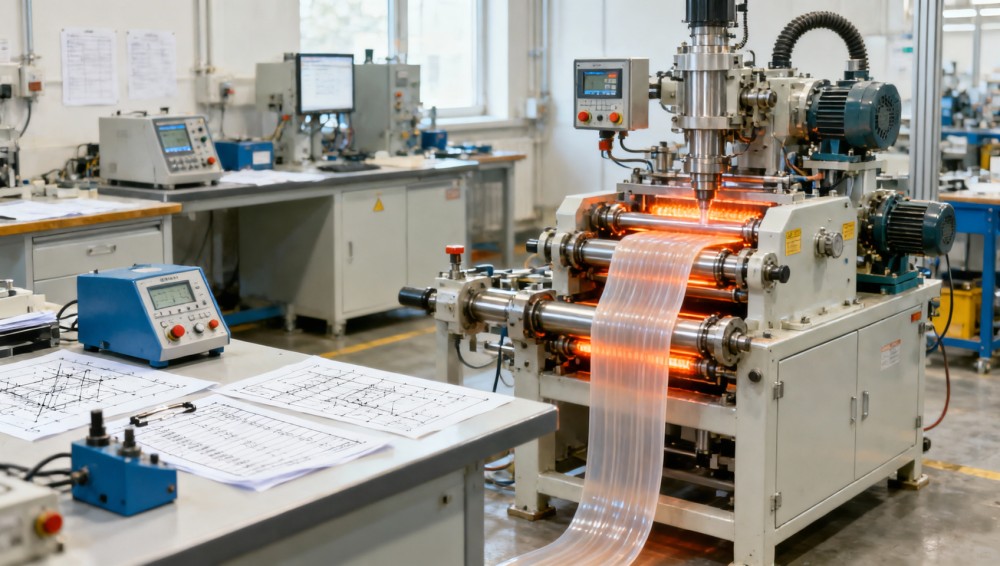
Electrical drawings, terminal schedules, drive documentation, and component lists can significantly reduce commissioning time. This is particularly relevant for older equipment that may have undergone incremental modifications. A control panel can contain obsolete drives, undocumented wiring changes, or components unavailable in the buyer’s region.
Buyers should identify the supply voltage, frequency, short-circuit rating assumptions, grounding arrangement, motor-control method, emergency-stop circuit, interlocks, heater control hardware, and temperature-sensor types. If the machine will cross borders, electrical and machinery-safety obligations may differ by destination and application. The purchaser should evaluate local requirements with competent electrical and safety personnel rather than assume that an existing panel satisfies current site rules.
For U.S. workplaces, OSHA’s machine-guarding requirements are set out in 29 CFR 1910 Subpart O, while electrical safety obligations may also apply under 29 CFR 1910 Subpart S. These regulations do not provide a universal acceptance certificate for used machinery; they establish employer obligations that must be considered in the installed condition. Source: U.S. Occupational Safety and Health Administration, 29 CFR Part 1910, Subparts O and S.
A Test Run Should Reproduce a Meaningful Operating Condition
A no-load rotation check can reveal seized components or obvious mechanical faults, but it is not a production test. The most useful demonstration runs material through the extruder long enough to reach thermal and mechanical stability. The material does not always need to be the buyer’s exact production resin, yet the substitution must be disclosed because material behavior changes torque, pressure, heating demand, venting behavior, and output characteristics.
A sound test plan identifies the material, moisture condition where relevant, feed method, screen pack or filtration arrangement, die or discharge setup, temperature setpoints, screw-speed range, and duration of each operating condition. It should define which observations will be recorded and which deviations would require investigation.
The buyer should also understand that a test conducted with an open discharge, rather than through a representative die or downstream restriction, may not demonstrate performance under normal pressure. Similarly, running at a conservative screw speed may conceal instability that appears near the intended production rate.
What to observe during the run
- Temperature response: Compare displayed and independently checked temperatures where practical. Large differences, slow recovery, or unstable zones can point to heater, sensor, controller, cooling, or wiring issues.
- Motor load and torque behavior: The trend is often more informative than a single reading. Erratic load at steady feed conditions may require investigation of feed consistency, screw wear, mechanical drag, or control behavior.
- Melt pressure: Pressure should be considered with the die, screen pack, material, temperature, and throughput. A stable value in one setup does not establish suitability for every product, but fluctuations can reveal process instability.
- Gearbox and bearing condition: Listen for abnormal noise and check for unusual heat, vibration, or oil leakage after the machine is under load.
- Output consistency: A timed collection of extrudate can provide a basic throughput check. The test record should state the collection duration and conditions rather than presenting the result as a universal capacity rating.
- Extrudate appearance: Look for unmelted particles, gels, contamination, surging, discoloration, bubbles, or inconsistent strand dimensions. These observations require interpretation because feedstock quality and die condition can also contribute.
A test report should record actual values rather than only a pass/fail statement. A practical format includes time stamps, setpoint and actual temperatures, screw speed, motor load, pressure, observed output, alarms, adjustments made, and a note of any component that could not be tested. Video can be helpful, but it should support—not replace—written operating data.
Use the Test Run to Define the Acceptance Boundary
The strongest purchase agreements connect inspection evidence to agreed acceptance conditions. This does not mean demanding a guarantee that an older extruder will behave like a new machine. It means defining a realistic boundary between verified condition and buyer-owned commissioning risk.
For example, an acceptance schedule may state that the extruder must rotate through an agreed speed range, heat each zone, maintain specified controls without unresolved alarms, operate with the stated test material for an agreed period, and show no abnormal leakage, vibration, or drive fault. If throughput or melt quality is included, the material, die, screen configuration, and operating conditions should be specified. Otherwise, the parties may later be comparing results produced under different conditions.
Many buyers also benefit from separating pre-shipment acceptance from site acceptance. Pre-shipment testing verifies the equipment before transport and disassembly. Site acceptance addresses correct reassembly, utility connection, integration with downstream equipment, safety guarding, and operation in the buyer’s actual process. The second stage matters because transport, rewiring, and line integration can introduce new faults.
When developing an evaluation checklist, the reconditioning considerations outlined by Machinery Reborn are relevant to the distinction between visual condition, component inspection, and operational verification. That distinction helps procurement teams avoid treating a refurbished appearance as proof of process readiness.
Common Gaps That Should Change the Commercial Decision
Some missing information can be managed with a contingency budget. Other gaps justify a deeper inspection, changed contract terms, or a decision not to proceed. The key is to rank missing evidence by consequence.
An unavailable original manual may be manageable if the machine’s electrical system has been fully documented and replacement components are identifiable. By contrast, absent wiring diagrams for a heavily modified control panel can create a substantial commissioning risk. Missing screw and barrel measurements may be acceptable for a low-value, non-critical application if the buyer plans a rebuild, but they are more serious when output consistency is central to the business case.
Procurement teams should be cautious when a seller cannot identify the test material, cannot explain recent repairs, declines a loaded test run, or provides capacity claims without stating operating conditions. These are not automatic signs of a defective machine. They are signals that the buyer has less evidence and should avoid pricing the asset as though its performance has been fully verified.
Delivery terms also deserve attention. A complete purchase file should clarify disconnection responsibility, fluid removal, preservation for shipment, lifting points, shipment dimensions, loose-item packing, export documentation where applicable, and the handover point for risk of damage. An extruder that reaches the site without its control drawings, matching cables, safety guards, or associated tooling may be inexpensive to acquire but expensive to commission.
Turn Evidence Into a Procurement Decision
Used-extruder purchases are rarely risk-free. The objective is to make the remaining risk visible, assign ownership, and ensure that the purchase price reflects what has actually been verified. A disciplined review combines condition records, configuration evidence, a technically relevant test run, safety and electrical evaluation, and a written acceptance framework.
The best decision is often not the machine with the lowest asking price or the newest cosmetic refurbishment. It is the machine for which the buyer can clearly answer four questions: what it is, what has been done to it, what it demonstrated under defined conditions, and what work remains before reliable production can begin.