
Related News
 Are Carbon Fiber Composites Ready for Mass Use in Construction Equipment?Oct 08, 2026
- How to Verify an Industrial Supplier’s Delivery Track RecordOct 08, 2026
 What Should Buyers Do When a Key Supplier Raises Prices Mid-Contract?Oct 08, 2026
- How Do Trade Sanctions Affect Heavy-Industry Supply Chains?Oct 08, 2026




Industry Briefing
Get the top 5 industry headlines delivered to your inbox every morning.
Related News
How sterile packaging validation changes pharmaceutical manufacturing process design





Sterile packaging validation is no longer just a compliance checkpoint—it’s a strategic driver reshaping pharmaceutical manufacturing processes from the ground up. As manufacturers adopt smart manufacturing technologies and high-volume manufacturing techniques, validation requirements directly influence manufacturing plant layout design, manufacturing material selection guide decisions, and large-scale manufacturing equipment integration. This shift also impacts manufacturing cost analysis tools, outsourcing strategies with manufacturing outsourcing companies, and adherence to evolving manufacturing safety regulations. For procurement personnel, decision-makers, and operations teams, understanding this linkage is critical to optimizing manufacturing supply chain management, ensuring manufacturing quality control standards, and advancing energy-efficient manufacturing solutions across global facilities.
From Compliance Gate to Process Architecture Anchor
Sterile packaging validation has evolved from a late-stage quality assurance step into a foundational specification that defines process architecture at the earliest design phase. Regulatory expectations—particularly under FDA 21 CFR Part 211, EU Annex 1 (2022 revision), and ISO 11607—now mandate that validation protocols be embedded in facility master planning, not appended post-construction. This means layout decisions—such as cleanroom classification zoning (ISO Class 5 vs. Class 7 buffer zones), airlock sequencing, and material flow segregation—must align with sterilization cycle parameters and environmental monitoring thresholds before civil engineering begins.
For heavy-industry–aligned engineering firms and EPC contractors serving pharma clients, this translates to tighter cross-functional coordination: HVAC designers must collaborate with sterilization equipment vendors to model heat load dispersion from steam autoclaves or VHP isolators; structural engineers must verify floor loading capacity for 3,500–5,000 kg integrated aseptic fill lines; and automation architects must validate PLC logic against ISO 13485-compliant change control workflows. Failure to integrate validation early adds 7–15 days to commissioning timelines and increases rework costs by an average of 22% (per 2023 ISPE Benchmarking Report).
Procurement teams face parallel implications. Material selection for piping, gaskets, and surface finishes must satisfy both mechanical durability (e.g., ≥10⁶ cycles for diaphragm valves) and extractables/leachables profiles validated per USP <735> and <1663>. A single non-compliant elastomer can trigger full revalidation of a filling line—delaying commercial launch by up to 12 weeks.
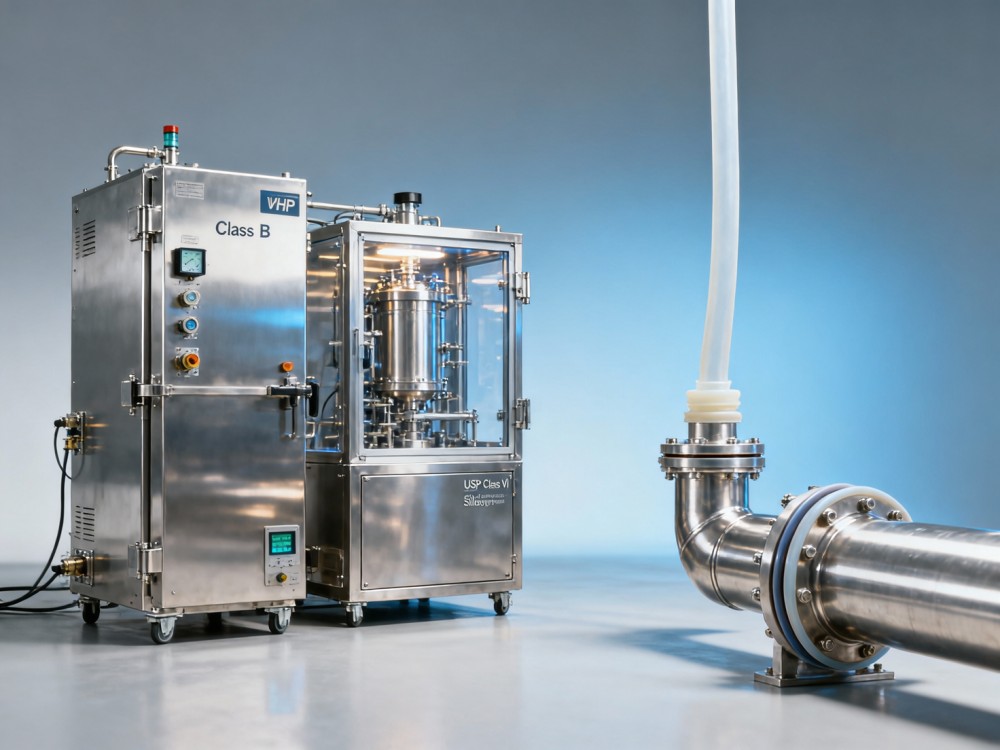
Impact on Equipment Integration and Automation Strategy
Validation requirements now dictate hardware and software specifications—not just for sterilizers and isolators, but for upstream and downstream systems. For example, real-time sterility assurance demands continuous monitoring of critical process parameters (CPPs): temperature uniformity (±0.5°C across chamber volume), pressure ramp rates (≤1.2 bar/min for steam penetration), and bioburden reduction logs (≥6-log reduction for SAL 10⁻⁶). These metrics constrain equipment selection far beyond nominal capacity.
Smart manufacturing integration compounds complexity. Validated SCADA systems must log timestamped, audit-trail-enabled data per 21 CFR Part 11—requiring hardware-level cryptographic signing, redundant storage (RAID-6 minimum), and secure time synchronization (NTP stratum ≤2). Legacy PLCs without firmware-signed firmware updates cannot meet current Annex 1 §8.49 requirements for cybersecurity in automated sterile processes.
The table below compares key integration criteria for three common sterile packaging equipment categories:
Decision-makers must prioritize equipment vendors with documented validation lifecycle support—not just IQ/OQ/PQ documentation, but ongoing change impact assessments, periodic revalidation scheduling tools, and regulatory update alerts. Vendors offering cloud-based validation data dashboards reduce manual review effort by 40% and accelerate audit response times by 65% (based on 2024 PharmTech survey of 87 global manufacturers).
Procurement Implications Across the Value Chain
Procurement professionals must now evaluate suppliers using four interdependent dimensions: technical validation readiness, supply chain resilience, service lifecycle coverage, and interoperability certification. A vendor’s ISO 13485:2016 certification alone is insufficient—procurement teams require evidence of ≥3 successful site-specific validations in the past 24 months, including at least one with a client operating under FDA and EMA dual jurisdiction.
Outsourcing strategies are equally affected. Contract manufacturing organizations (CMOs) must disclose their validation backlog metrics: average PQ completion time (industry benchmark: ≤8 weeks), number of open CAPAs related to packaging validation (target: ≤2 active per site), and spare parts availability for critical validation sensors (minimum 95% stock availability for thermocouples, pressure transducers, and H₂O₂ probes).
The table below outlines six non-negotiable procurement evaluation criteria for sterile packaging validation-critical components:
Energy efficiency also enters procurement calculus: validated steam systems consuming >2.8 kg steam/kg load fall outside Tier 3 Energy Star benchmarks for industrial sterilization. Procurement teams should request thermal efficiency test reports conducted per ASTM E2878-22.
Strategic Action Steps for Cross-Functional Teams
To operationalize validation-driven process design, cross-functional teams should execute the following five-phase implementation sequence:
- Phase 1 (Weeks 1–4): Conduct validation gap assessment against latest Annex 1 and FDA draft guidance—focusing on environmental monitoring, personnel gowning validation, and media fill frequency alignment.
- Phase 2 (Weeks 5–10): Map existing equipment control architecture against 21 CFR Part 11 and IEC 62304 requirements; identify firmware upgrade paths or hardware replacements.
- Phase 3 (Weeks 11–16): Redesign material flow diagrams to eliminate cross-contamination risks—validated via computational fluid dynamics (CFD) modeling of cleanroom airflow patterns.
- Phase 4 (Weeks 17–22): Negotiate supplier SLAs covering validation support response time (≤4 business hours for critical alarms), spare parts lead time (≤72 hours for Class I sensors), and annual revalidation planning windows.
- Phase 5 (Weeks 23–26): Integrate validation KPIs into digital twin models for predictive maintenance scheduling and regulatory readiness scoring.
For information调研者 and procurement decision-makers, this evolution underscores one imperative: sterile packaging validation is no longer owned solely by QA. It is a shared responsibility across engineering, IT, procurement, and operations—with measurable impact on capital expenditure timing, total cost of ownership, and time-to-market velocity. Delaying integration until late-stage design locks in suboptimal configurations, inflates lifecycle costs by 18–35%, and constrains scalability.
To navigate this shift effectively, stakeholders require actionable intelligence—not theoretical frameworks. Access our latest industry briefing on validation-aligned procurement criteria, facility design checklists, and vendor due diligence scorecards tailored for heavy-industry–integrated pharmaceutical manufacturing ecosystems.
Get your customized validation-readiness assessment toolkit today.